What Makes Natural Soya Bean Tofu Cat Litter the Rising Star of Eco-Friendly Pet Care?
Cat litter buyers who spent the last decade sourcing bentonite clay are now fielding a different kind of request from retail partners: something plant-based, lower dust, and easier to explain on a product label. That shift shows up in the numbers. The global natural cat litter market was valued at roughly $9.02 billion in 2026 and is projected to grow at a 4.59% CAGR to reach $12.92 billion by 2034.(Source: Market Data Forecast, “Natural Cat Litter Market”)
Within that broader category, plant-based litter—tofu litter being the largest sub-segment—is expanding even faster, with reported growth around 12% CAGR, making it the fastest-moving vertical in the litter industry.(Source: Accio, “Trends of Tofu Cat Litter”)
For a B2B buyer building or refreshing a natural tofu cat litter private label program, natural soya bean tofu cat litter isn’t a niche add-on anymore. It’s becoming a category buyers need to understand on its own terms before they can evaluate any single supplier’s version of it.
What Tofu Cat Litter Actually Is
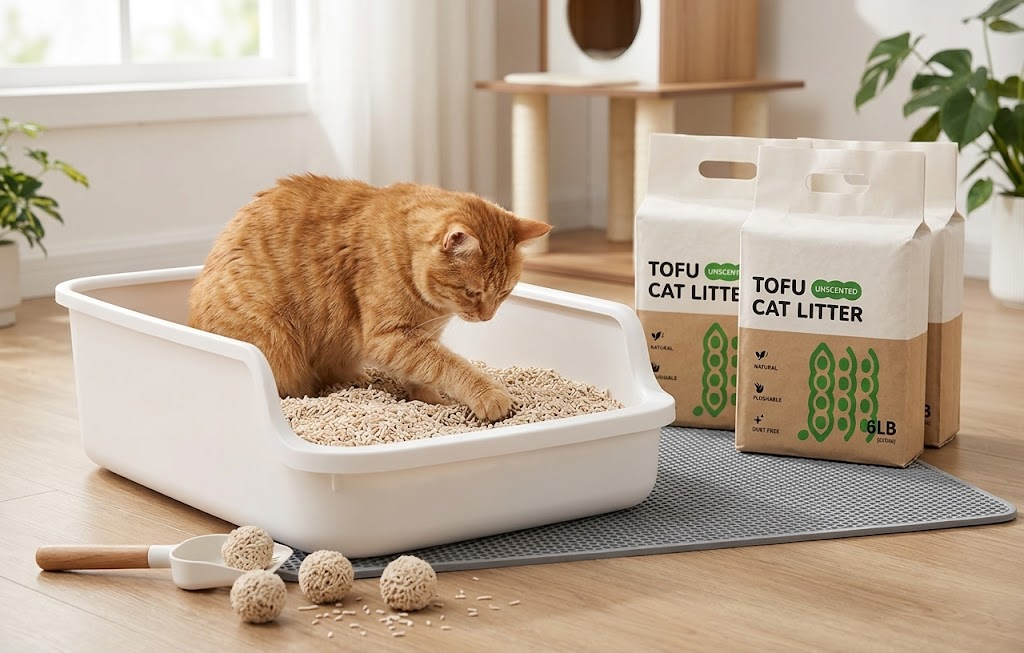
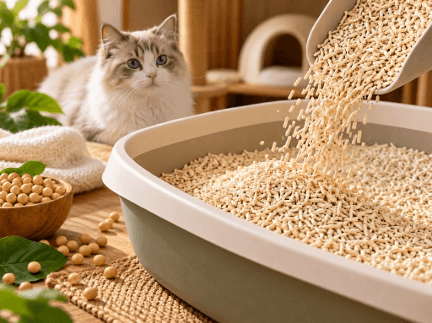
Tofu cat litter is a granulated litter made primarily from plant fiber byproducts—typically soybean pulp (okara), sometimes blended with corn starch, pea fiber, or wheat starch as a binding agent. The fiber is pressed and dried into small cylindrical or spherical granules that absorb liquid and clump on contact, similar in function to clay, but from an agricultural rather than mineral source.
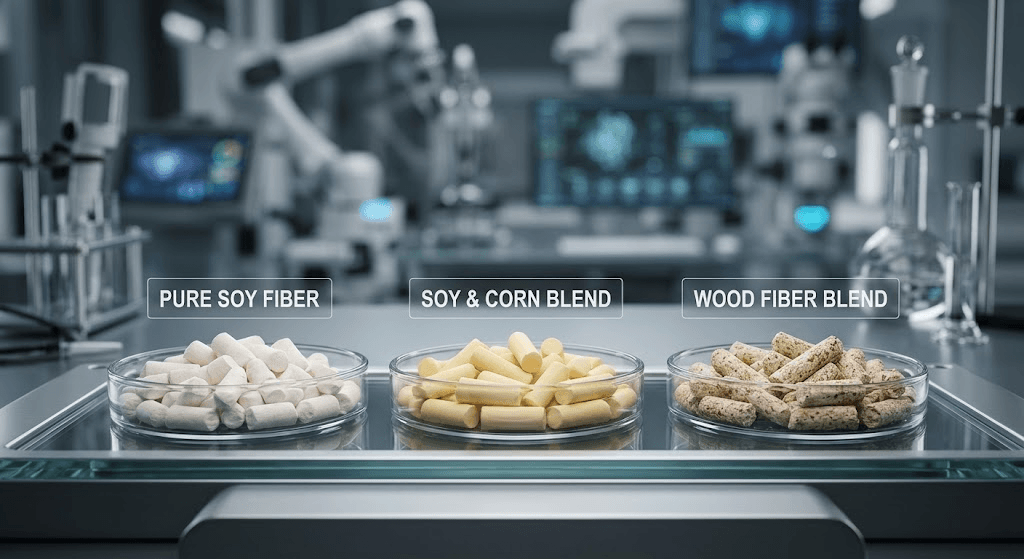
Within the tofu litter category, there are a few recognizable subtypes:
Pure soy fiber litter – soybean pulp with minimal binders, generally softer clumps, higher biodegradability
Soy-corn blend litter – soy fiber combined with corn starch for firmer clumping and better structural integrity during shipping
Scented vs. unscented lines – scented versions use added fragrance to mask ammonia odor; unscented versions rely purely on the fiber’s natural absorption
Mixed-material variants – some formulas add a small ratio of wood or plant-fiber granules (commonly around an 8:2 blend) for extra odor control without introducing fragrance chemicals
This variety matters because “tofu litter” on a spec sheet can mean fairly different products depending on the binder ratio and granule treatment—two lines both labeled tofu litter can perform quite differently in clumping strength and dust levels.
Core Dimensions Buyers Should Actually Evaluate
Most sourcing conversations around this category end up circling the same handful of performance dimensions. Understanding the trade-offs behind each one saves a lot of back-and-forth during supplier vetting.
Clumping speed and firmness. Faster clumping generally means less odor exposure time and easier scooping, but very fast clumping formulas sometimes sacrifice firmness—clumps that break apart during scooping create more mess, not less. Buyers should ask for clumping time under standardized conditions rather than accepting a general claim.
Dust levels. This is the single most cited complaint driving retailers away from clay litter, and it’s also where tofu litter formulas vary widely depending on how the granules are dried and screened. Low-dust processing adds cost, so a supplier quoting an unusually low price on a “dust-free” claim is worth double-checking.
Odor control approach. Fragrance-based masking is cheaper to formulate but has become a liability with consumers sensitive to synthetic scent; unscented, fiber-based absorption is the trend line most premium retail buyers are chasing, even though it depends more heavily on granule quality to perform well.
Tracking (granule carry-out). Granule size and surface texture determine how much litter ends up outside the box. Smaller, smoother granules track less but can be marginally more prone to dust generation if not properly treated—this is a real trade-off, not a marketing footnote.
Biodegradability and disposal claims. Flushability and compostability are strong differentiators versus clay, but they only hold up if the fiber-to-binder ratio is genuinely water-soluble rather than just marketed as “eco.”
Freight and packaging efficiency. Plant-fiber litter is significantly lighter than clay by volume, which affects landed cost per container and is often underweighted in early sourcing conversations that focus only on unit price.
How Tofu Litter Compares to Other Litter Categories
|
Litter Type |
Clumping Strength |
Dust Level |
Odor Control |
Typical Cost Tier |
Biodegradability |
|
Bentonite Clay |
Strong |
Medium-High |
Medium |
Low |
Low(mined mineral) |
|
Corn-Based |
Medium-Strong |
Low-Medium |
Medium |
Mid |
High |
|
Tofu (Soybean) |
Medium |
Low |
Medium-High |
Mid-High |
High |
|
Wood-Based |
Weak-Medium |
Low |
Medium |
Low-Mid |
High |
|
Cassava Mixed |
Medium-Strong |
Low |
High |
Mid |
High |
The comparison shows why tofu litter occupies a specific commercial niche: it isn’t the cheapest option, and it doesn’t out-absorb silica gel, but it’s the only category that combines strong clumping with genuine biodegradability and light shipping weight—three things retail buyers are increasingly asked to deliver simultaneously by their own end customers.
Efficiency and Cost-Effectiveness in Practical Terms
Cost-per-use is the metric that actually matters to a buyer stocking shelves, not just unit price. Tofu litter’s lighter weight lowers freight cost per container load compared to bentonite, which partially offsets its higher raw material cost. Clumping efficiency also affects how much product a household consumes per month—firmer, faster clumps mean less litter wasted on partial absorption, which supports a higher price point without necessarily hurting repeat purchase economics.
Regional demand patterns reinforce where this category is landing commercially. Europe currently holds the largest share of the global cat litter market at approximately 37.6%, driven in part by stronger regulatory and consumer pressure around synthetic and mineral-based products.(Source: Mordor Intelligence, “Cat Litter Market”)
North America isn’t far behind in growth trajectory, with the broader cat litter market there expanding at roughly 4.4% to 4.8% CAGR, a pace consistent with the region’s fast adoption of natural and plant-based formats.(Source: Mordor Intelligence / Future Market Insights, “Cat Litter Market”)
For buyers deciding where to launch or expand a plant-based line, these two regions currently offer the clearest combination of market size and category growth.
The Position of Lolostar Tofu Cat Litter’s Specific Formula within This Market Landscape
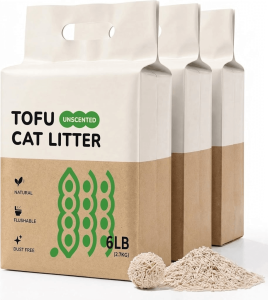
As a specific product within this category, natural tofu cat litter is based on 100% plant-based ingredients—food-grade soya fiber combined with corn starch. Some unscented products incorporate natural deodorizing wood or plant fiber granules in an 8:2 ratio to replace synthetic fragrances. The granule diameter is approximately 2 millimeters, placing it at the finer end of the tofu cat litter spectrum. It is specifically designed to minimize tracking while avoiding an increase in dust levels—this directly addresses the issue of tracking highlighted earlier, rather than sidestepping it. Setting aside marketing rhetoric, this formulation has been tested to achieve 99.9 per cent dust control, with clumping time of approximately 3 seconds; furthermore, due to the excellent water solubility of its fiber structure, it can be flushed down the toilet in small quantities. The standard packaging specification is 6 pounds per bag, typically sold in sets of two or three bags—a detail that is crucial for buyers calculating freight costs per container based on the efficiency criteria mentioned above.
This is merely one of many viable formulation options within this product category; for any purchaser evaluating natural tofu cat litter, a more important point to bear in mind is this: what truly determines whether a product can meet the performance standards demanded by today’s retail buyers is the particle size, binder ratio and dust-reduction process—not the word ‘tofu’ on the label.
Lolostar: Your specialist supply chain partner for Natural Soya Bean Tofu Cat Litter
As a specialist manufacturer and supplier of pet products, Lolostar has delved deep into the supply chain of Natural Soya Bean Tofu Cat Litter, mastering proven formulation technology and possessing OEM/ODM customization capabilities. We are able to provide brand clients with end-to-end support, ranging from specification customization and packaging design to bulk delivery.
The product complies with the safety standards of the EU REACH Regulation (all SVHC requirements met), and the factory has been certified to the ISO 9001 Quality Management System, ISO 14001 Environmental Management System and ISO 45001 Occupational Health and Safety Management System (certificate numbers: 10426Q00119R001 / 10426E00081R001 / 10426S00081R001), and meet the market access requirements of major pet product markets such as Europe, the US and Japan.
Launch your Natural Soya Bean Tofu Cat Litter product range
If you are looking for a reliable supply chain partner or would like to learn more about the specifications and customization options for our “Natural Soybean Tofu Cat Litter”:
📧 Please email [email protected] to request product technical documentation and free test samples.
Frequently Asked Questions (Q&A)
Q1: What's the difference between soy fiber and soy-corn blend tofu litter, and does it affect order specifications?
Pure soy fiber litter typically clumps softer and biodegrades faster, while soy-corn blend formulas hold firmer clumps during transit and scooping. Buyers should specify binder ratio in purchase agreements rather than relying on the general “tofu litter” label, since the two variants can have different bulk density and packaging requirements.
Q2: How is dust level typically measured or verified when evaluating a soya tofu cat litter manufacturer?
Dust performance is usually assessed through settling tests after agitation, with results reported as a percentage of dust-free material. Buyers should request this data with test conditions specified rather than accepting a flat percentage claim without methodology.
Q3: What MOQ ranges are common for bulk soya tofu litter orders?
MOQs vary by supplier and packaging format, but plant-fiber litter generally allows lower entry MOQs than mineral-based litter because raw material sourcing and production runs are more flexible. Buyers should confirm MOQ against specific bag size and private label tooling requirements before comparing quotes.
Q4: Is soya bean tofu cat litter genuinely flushable, or is that a marketing claim?
Flushability depends on the fiber-to-binder ratio breaking down in water without clogging. Formulas with a high water-soluble fiber content, used in small quantities per flush, generally hold up to this claim, but buyers should ask for disposal guidance (such as maximum recommended quantity per flush) rather than treating “flushable” as unconditional.
Q5: What should a buyer check before finalizing a soya bean cat litter OEM supplier agreement?
Key checks include raw material sourcing consistency (soybean fiber quality varies by supplier region), production capacity for private label tooling, dust and clumping test data across multiple batches, and packaging/export documentation experience—since inconsistent batch quality is the most common complaint in this category.
Q6: How does soya cat litter export pricing typically compare to clay or silica litter?
Tofu litter generally sits at a mid-to-premium price point above clay but below silica gel. Its lighter shipping weight can offset part of the raw material cost difference on a landed-cost basis, which is why freight terms should be part of any pricing comparison rather than unit price alone.
Articles on the Natural Soybean Tofu Cat Litter Series
1. What Makes Natural Soya Bean Tofu Cat Litter the Rising Star of Eco-Friendly Pet Care? (Current Article)
2. Tofu Cat Litter vs. Bentonite and Crystal Litter: Which One Truly Wins?
3. Is Soya Bean Tofu Cat Litter the Next Big Trend in the Global Pet Market?
4. Why Does Tofu Cat Litter Pricing Vary So Much Between Suppliers?
5. How Can Buyers Avoid Costly Mistakes When Sourcing Tofu Cat Litter?
6. From Soybean Waste to Clumping Litter: What Really Happens in Production?
7. Can Customized Formulas Solve Your Brand’s Cat Litter Pain Points?
8. What Quality Standards Separate Premium Tofu Cat Litter from the Rest?