What Makes a Durable Cotton Dog Chew Toy Worth Stocking in 2026?
Pet spending in the US hit $158 billion in 2024 and is projected to climb to $165 billion by 2026, a trajectory that keeps surprising even seasoned category buyers.(Source:APPA (American Pet Products Association)《Industry Trends and Stats》)
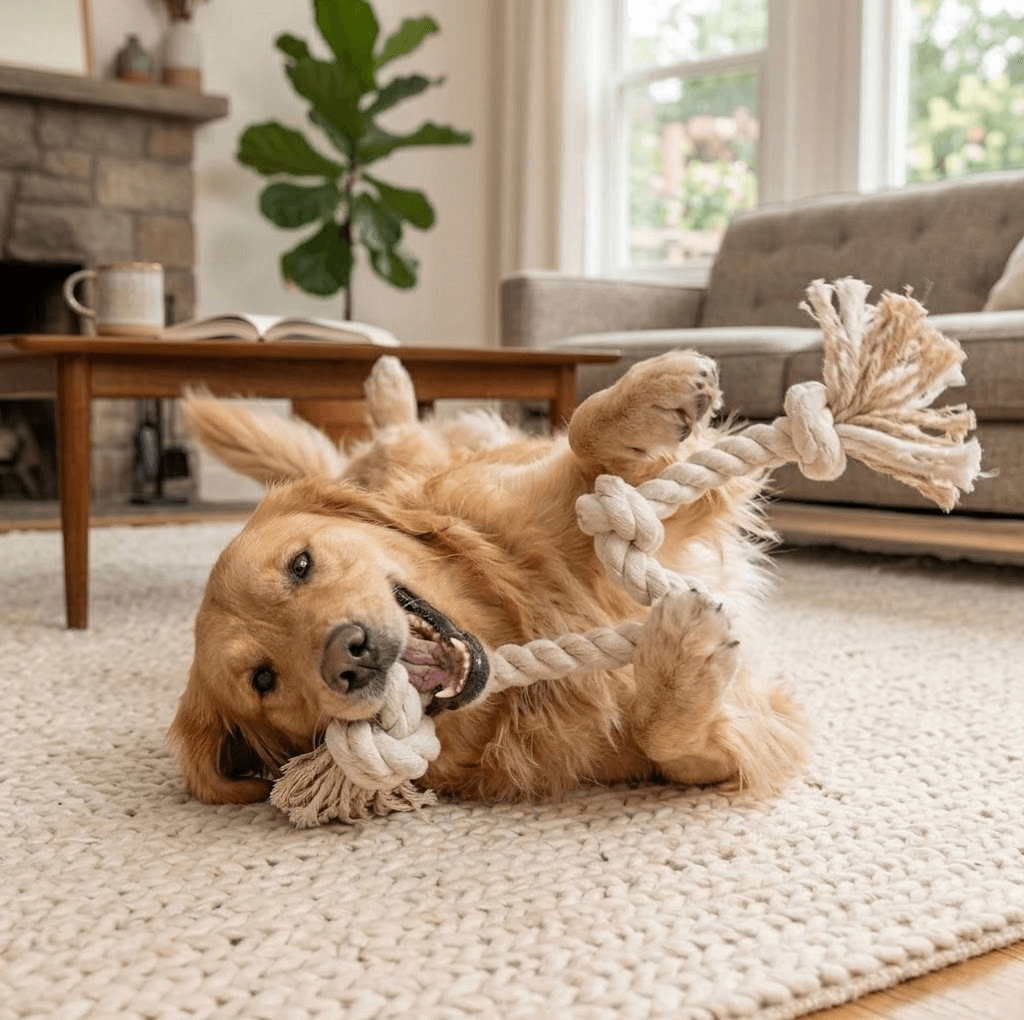
Toys are a meaningful slice of that spend, and within toys, one product family keeps showing up on reorder lists: the durable cotton dog chew toy. It’s not flashy. It doesn’t come with batteries or app connectivity. But it sells, restocks, and holds margin in a way that a lot of newer categories can’t match. This article breaks down what this category actually is, what buyers should be evaluating before placing a purchase order, and where cotton rope products sit relative to the alternatives.
Sizing Up the Category: Toys, Dogs, and Chewing Behavior
The global pet toys market is projected to reach $4.7 billion by 2026 and roughly double to $9.3 billion by 2036, growing at a 6.9% CAGR — with the US market outpacing the global average at 7.0%.(Source::Future Market Insights (FMI)《Pet Toys Market》)
Dogs are the reason this market moves at all. Dog toys are expected to account for 52% of global pet toy revenue in 2026, driven largely by a behavior pattern that doesn’t exist in most consumer categories: dogs destroy their toys, and owners replace them without much hesitation. That “wear-and-replace” cycle is the actual engine behind repeat purchasing, not novelty or seasonal demand”.
Within dog toys, chew toys are the single largest sub-segment, holding 36% of the market in 2026. The report attributes this to durability-focused rope and knot products that burn off a dog’s energy while requiring frequent replacement — a combination retailers actively look for because it supports both retention and turnover.(Source:Future Market Insights (FMI)《Pet Toys Market》)
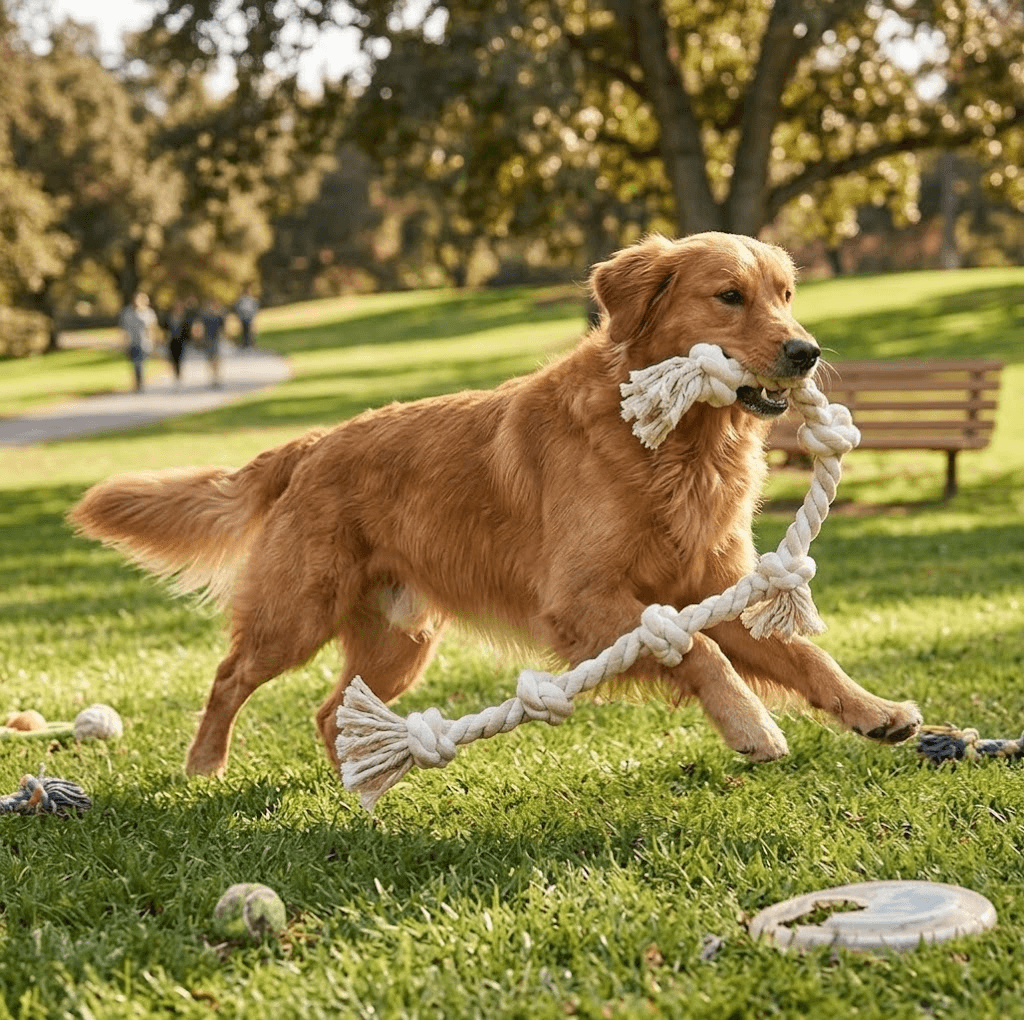
What Exactly Falls Under "Cotton Dog Chew Toy"?
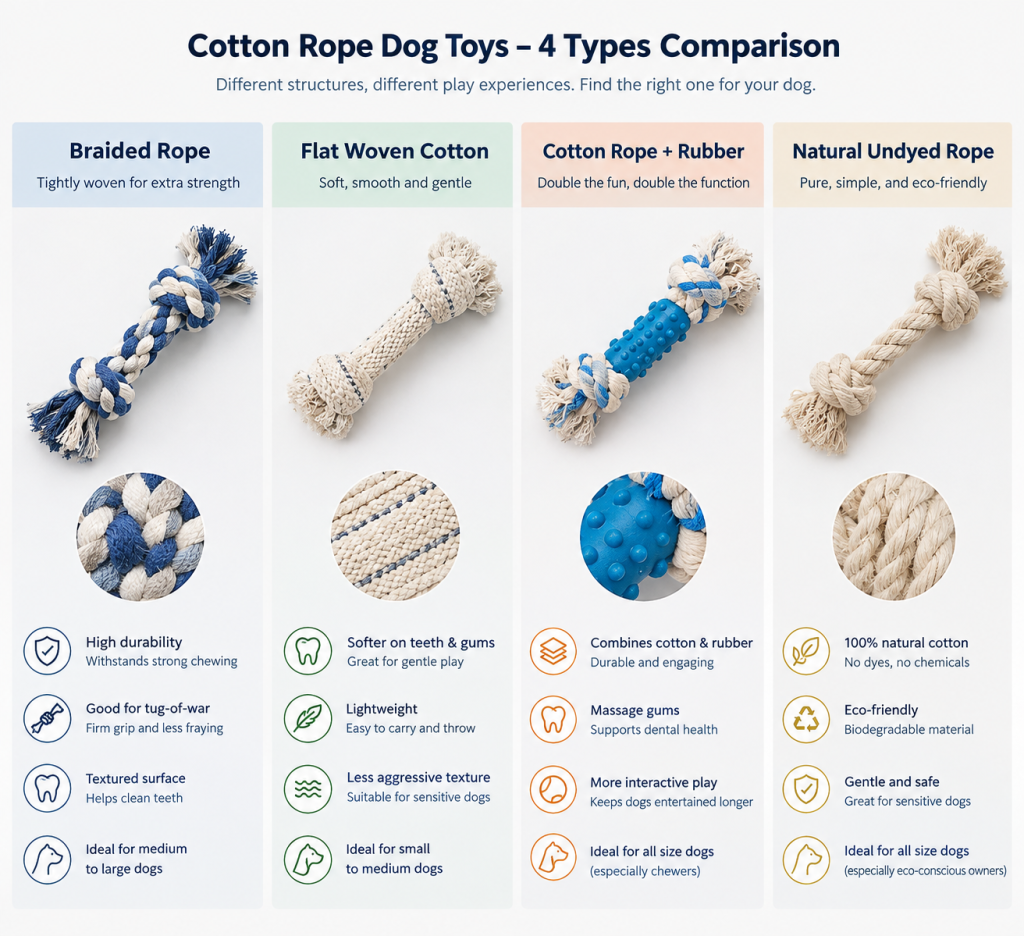
The category is broader than it sounds. At its core, a cotton dog chew toy is any chew product built primarily from woven or twisted cotton fiber, rather than rubber, nylon, or synthetic plush. But the sub-types differ enough that they serve different shelves and different dogs.
Braided or knotted rope toys — the most recognized format, made from multiple cotton strands twisted and knotted into shapes, sometimes with additional knots at both ends for tug play.
Woven flat cotton toys — flatter, denser weave patterns, often marketed for gentler chewers or puppies.
Cotton-rubber hybrids — a cotton rope core wrapped around a rubber or TPR insert, aimed at extending lifespan for stronger chewers.
Cotton-plush combination toys — soft plush bodies with cotton rope accents, positioned more toward comfort/companion play than heavy chewing.
Undyed natural cotton toys — a smaller but growing sub-type, where the fiber is left in its raw, unbleached state to avoid dye chemicals altogether, appealing to buyers building “natural” or “eco” product lines.
The distinction matters for sourcing because “cotton chew toy” as a search term or product listing can mean a $1.50 FOB item or a $4+ FOB item, depending entirely on which of these sub-types and construction grades is behind it.
Core Dimensions Buyers Should Actually Be Evaluating
Most buyers new to this category default to comparing price per unit and color options. That’s not where the real differentiation sits. A handful of dimensions determine whether a cotton chew toy performs well on shelf and holds up against return claims.
Fiber density and weight. A thin, loosely twisted rope will fray within days under a determined chewer. Weight per unit length is a reasonable proxy for how tightly the cotton is wound and how much raw material actually went into the product — a heavier rope of the same length generally means denser fiber packing, not just a bigger toy.
Knot construction. Loose knots unravel under repeated pulling; the failure mode isn’t dramatic, it’s gradual, and it shows up as a slow rise in the return rate rather than an obvious defect.
Dye and chemical treatment. Undyed or low-chemical cotton reduces the risk of surface treatments flaking off during chewing, which matters both for ingestion safety questions and for retailers positioning around “natural” claims.
Size-to-dog-size matching. A cotton rope built for a toy breed will not survive contact with a large or extra-large adult dog’s jaw. This is one of the most common mismatches in sourcing — buyers order a rope toy without confirming it was engineered for the bite force of the dogs it’s being marketed to, which is exactly the kind of judgment call an experienced aggressive chewer toy manufacturer is expected to get right at the design stage.
Washability. Cotton absorbs saliva and dirt in a way rubber doesn’t. Whether the product is machine-washable affects both consumer satisfaction and how the toy is marketed on packaging.
The trade-off buyers constantly navigate is durability versus cost. A denser, tighter-knotted, higher-weight cotton rope costs more to produce and ship (weight-based freight), but it lowers the return rate tied to premature fraying. Buyers targeting a low price point often accept a shorter product lifespan as a deliberate trade-off; buyers building a durability-focused or “aggressive chewer” line typically pay up for the denser construction because the alternative is refund and complaint volume.
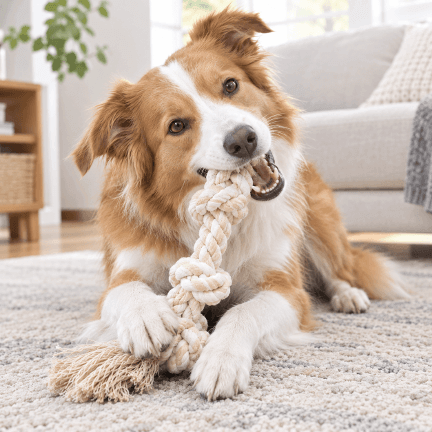
How Cotton Chew Toys Stack Up Against Other Materials
Attribute | Cotton Rope Toys | Rubber Chew Toys | Nylon Chew Toys | Plush Toys |
Typical durability (aggressive chewers) | Moderate to high (density-dependent) | High | High | Low |
Ingestion safety perception | High (soft fiber vs. hard fragments) | Moderate | Moderate | Moderate |
Unit cost range | Low to mid | Mid to high | Mid | Low |
Washability | High | High | Moderate | Low |
Replacement frequency (demand driver) | Frequent | Less frequent | Less frequent | Very frequent |
Best-fit dog size | Small to XL (construction-dependent) | Medium to XL | Medium to XL | All sizes |
The interesting point in this table for retail buyers is the replacement frequency column. Rubber and nylon chews win on raw longevity, but that longevity works against repeat purchase velocity. Cotton rope’s shorter lifespan, combined with its low unit cost and strong safety perception, is exactly why it holds the largest single-segment share among chew toys — it’s not the toughest option on paper, it’s the one that keeps customers coming back to reorder.
Cost-Efficiency: Where the Margin Actually Sits
Cotton rope toys sit in a favorable cost-efficiency zone for a few structural reasons. Raw cotton fiber cost is relatively low and stable compared to petroleum-based rubber or nylon inputs, which have seen more price volatility. Manufacturing is less capital-intensive than injection-molded rubber toys — no mold tooling investment required, which lowers the barrier for buyers wanting pet chew toy OEM production or custom cotton chew toy private label runs in smaller batches.
On the retail side, the “wear-and-replace” dynamic discussed earlier means a cotton chew toy doesn’t need to last a customer six months to be a good business — it needs to survive long enough to satisfy the buyer, then get replaced. That shifts the profitability logic away from “maximum lifespan” and toward “acceptable lifespan at the lowest defensible unit cost,” which is a different design target than, say, a rubber chew marketed on indestructibility. It’s also worth noting that for buyers planning bulk cotton dog toys export programs, this lower cost base and simpler tooling requirement translate directly into more favorable landed-cost economics across large order volumes.
Where This Product Category Shows Up in Practice
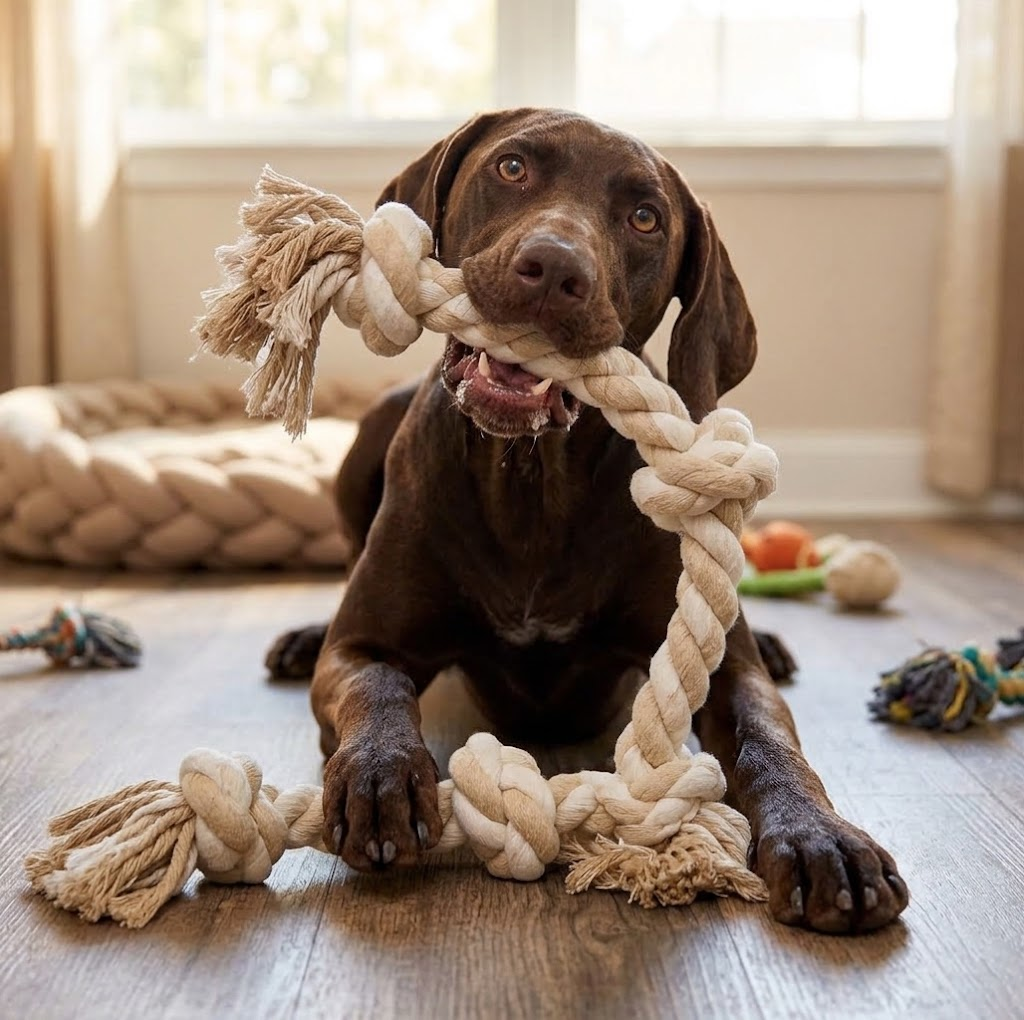
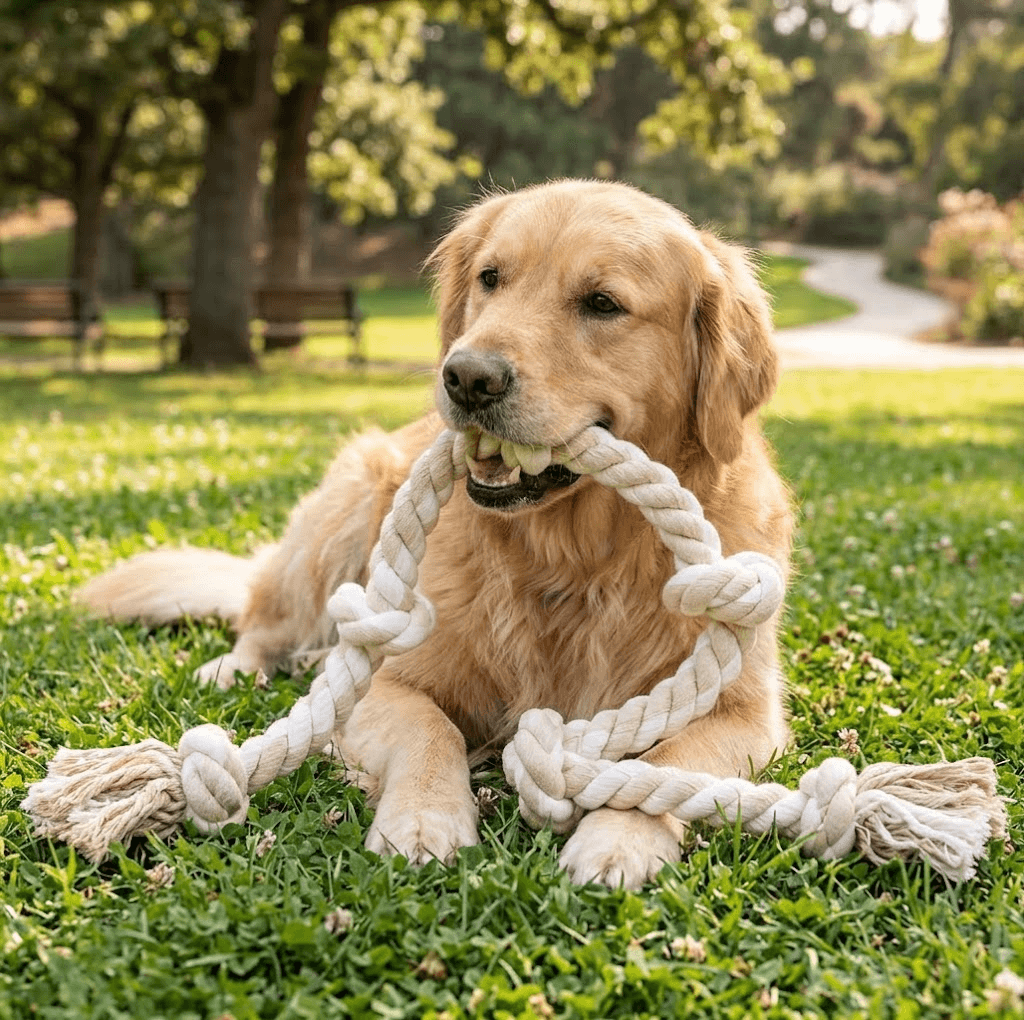
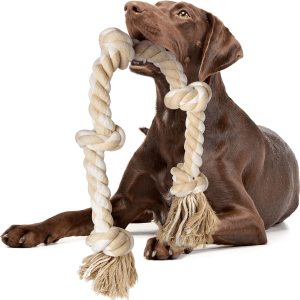
Lolostar, a natural cotton dog toy supplier, offers a cotton chew toy line that’s a useful reference point for how these category-level trade-offs get resolved in an actual product. The toy is built from 100% natural washable cotton, left undyed rather than color-treated, which addresses the ingestion-safety concern raised earlier without relying on marketing language alone. It’s constructed at 3 feet (36 inches / about 91.4 cm) in length and weighs 750 grams — a weight that’s noticeably higher than lightweight rope toys on the market, which is the density factor buyers should be checking for when durability claims are made. The rope is finished in an irregular knotted shape in a natural beige/white tone, sized specifically for large, extra-large, and adult dogs with aggressive chewing habits, for both indoor and outdoor use.
That combination — high fiber weight, undyed material, and sizing calibrated to strong chewers rather than a generic “one size fits most dogs” approach — reflects the core dimensions covered above: density for durability, undyed cotton for safety perception, and size-matching to reduce mismatch-driven complaints.
The durable cotton dog chew toy category isn’t going to be reinvented by a single new material breakthrough. Its growth is tied to a simple, repeatable behavior — dogs chew, ropes fray, owners buy again — and buyers who understand which construction variables actually drive that replacement cycle are better positioned to select suppliers than those comparing toys on price and color alone.
These figures line up with the trade-off logic described above: the sodium ore component provides clumping strength closer to bentonite-level performance, the tofu and cassava components support biodegradability, and the SAP and baking soda additions target absorption and odor control specifically — rather than any single ingredient trying to do all the work at once.
Lolostar: Your Professional Supply Chain Partner for Durable Cotton Dog Chew Toys
As a professional manufacturer and supplier of pet products, Lolostar has deep roots in the supply chain for Durable Cotton Dog Chew Toys. With mature production processes and a robust quality control system, as well as OEM/ODM customization capabilities, we provide brand clients with end-to-end support—from custom specifications and packaging design to bulk delivery.
Our products comply with the safety standards of the EU REACH Regulation (all SVHC requirements met), and our factory has obtained ISO 9001 Quality Management System certification, ISO 14001 Environmental Management System certification, and ISO 45001 Occupational Health and Safety Management System certification (Certificate Numbers: 10426Q00119R001 / 10426E00081R001 / 10426S00081R001) and meet the market access requirements of major pet product markets, including Europe, the United States, and Japan.
Launch Your Durable Cotton Dog Chew Toy Product Line
If you are looking for a reliable supply chain partner or would like to learn more about the specifications and customization options for our Durable Cotton Dog Chew Toy:
📧 Email us at [email protected] to request product technical documentation and free test samples
Frequently Asked Questions (Q&A)
Q1: What certifications or safety checks should a buyer request for cotton dog chew toys before placing an order?
At minimum, ask for material composition documentation confirming the cotton content and any dye or chemical treatment used, since undyed or low-chemical fiber is often a stated safety differentiator in this category. Request physical test reports covering tensile strength (knot pull testing) and, where relevant to your market, chemical safety testing appropriate to pet product import requirements in your destination country.
Q2: How is durability typically tested for cotton rope chew toys before mass production?
Common approaches include controlled pull-testing on knots and fiber joints, simulated chew-cycle testing, and weight/density measurement per unit length as a proxy for fiber tightness. Buyers sourcing for aggressive-chewer product lines should specifically request pull-strength data rather than relying on visual inspection alone.
Q3: What's a reasonable MOQ range for custom cotton chew toy private label production?
This varies by supplier and by whether tooling or custom packaging is involved, but cotton rope products generally have lower MOQ thresholds than injection-molded rubber or nylon toys, since no mold investment is required. Buyers should confirm MOQ per color/size variant separately, since custom shapes or private label packaging can raise the threshold.
Q4: How can a buyer evaluate whether a supplier's quality control is consistent across production batches?
Ask for batch-level weight and dimension records rather than just a single sample report, since weight is a practical indicator of fiber density consistency in cotton rope products. Requesting a pre-shipment inspection report, in addition to the factory’s internal QC data, gives an independent check on whether early samples match bulk production.
Q5: Why do cotton chew toys typically have a shorter replacement cycle than rubber or nylon chews, and does that affect return rate expectations?
Cotton fiber wears through fraying and unraveling rather than surviving intact like molded rubber, so a shorter lifespan is expected and shouldn’t automatically be read as a defect. Buyers should set return-rate benchmarks based on premature failure (within days) rather than gradual wear over weeks, which is normal for this material.
Q6: What should a buyer check during a supplier facility review specific to bulk cotton dog toys export production?
Beyond general factory audit items, ask to see raw cotton fiber sourcing records, dyeing/treatment processes (or confirmation of an undyed process), and in-line weight-checking during production, since these directly affect the safety and durability claims discussed earlier in sourcing conversations.
Series of Articles on Durable Cotton Dog Chew Toys
1. What Makes Durable Cotton Dog Chew Toys a Rising Favorite in the Pet Industry? ( Current Article)
2. Cotton Rope Toys vs. Rubber Chew Toys: Which One Truly Lasts Longer?
3. Why Are Eco-Friendly Cotton Dog Toys Trending Across Global Pet Markets?
4. What Really Drives the Price of a Durable Cotton Dog Chew Toy?
5. How Can Buyers Identify High-Quality Cotton Chew Toy Suppliers?
6. From Raw Cotton to Finished Toy: What Does the Production Journey Look Like?
7. Can Cotton Dog Chew Toys Be Fully Customized for Your Brand?
8. How Is Safety Tested Before a Cotton Chew Toy Reaches Your Dog?