Tofu Cat Litter vs. Bentonite and Crystal Litter: Which One Truly Wins?
For a retail or private-label buyer, the question is rarely which litter is “best” in the abstract. It is which litter type fits your channel, your return-rate tolerance, your freight budget and your brand position. Tofu cat litter has moved from a niche line to a mainstream category, and it now sits next to two long-established formats: clay-based bentonite and silica crystal. This article compares the three on formulation, function, cost structure and channel fit, so that range planning decisions rest on how each type is made and where it performs.
Why Litter Type Is a Sourcing Decision, Not Just a Product Choice
Each litter type carries a different cost structure, shipping profile, complaint pattern and regulatory-sensitivity profile. A bentonite line is heavy to freight and dusty to handle. A crystal line is light and long-lasting but priced high per unit and unfamiliar to some shoppers. Tofu litter sits between them on weight and tends to carry a “plant-based” positioning, but it depends heavily on formula quality, because the raw materials are agricultural by-products and not a single mined mineral.
Market data points to why buyers are paying attention. Dataintelo estimates the global tofu cat litter market at about USD 1.8 billion in 2025, growing to about USD 4.6 billion by 2034, a CAGR of 11.0%.(Sources:Dataintelo《Global Tofu Cat Litter Market》)
Classification by Raw Material Formulation
Bentonite (Mineral Clay)
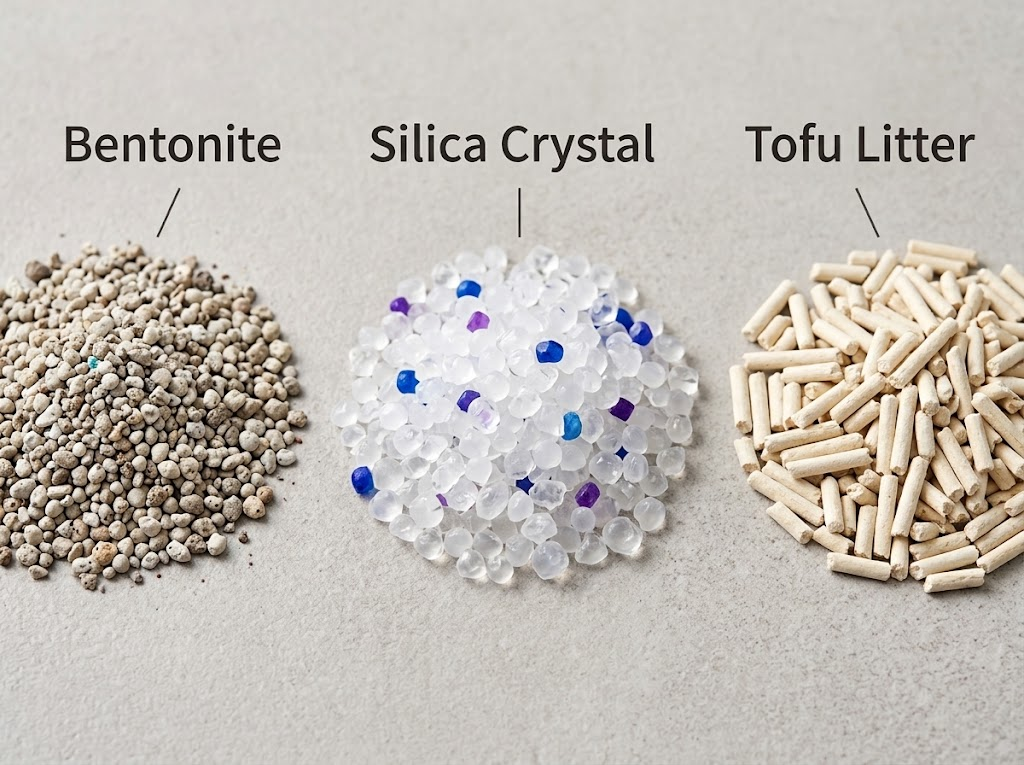
Bentonite is a naturally mined clay that swells and binds when wet, which is the basis of clumping. It is the traditional volume leader. Its formulation is simple, with variation mainly in sodium versus calcium content, particle grading and any added fragrance or odor-control agents. The trade-offs are weight, dust and the fact that it is a mined, non-biodegradable material.
Silica Crystal (Silica Gel)
Crystal litter is made from silica gel beads that absorb liquid into the pore structure instead of clumping. It is light relative to its absorption capacity and is typically positioned as a low-dust, long-interval-change product. It does not clump in the conventional sense, so it serves a different use pattern from clumping litters, and it is usually priced at the upper end of the three.
Tofu Litter (Plant-Fiber Based)
Tofu litter is built from plant by-products, usually soy residue or similar fibers, bound and extruded into pellets. The formula determines nearly everything: absorption, clumping speed, dust and how the pellet holds its shape. Because the base materials are fibers and starches, manufacturers can vary pellet diameter, color and scent without changing the underlying chemistry.
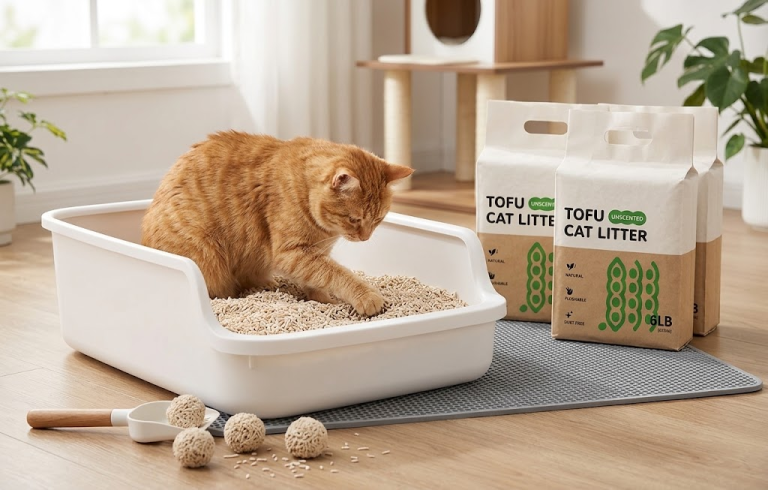
Lolostar’s tofu litter formula, for example, uses four ingredients: soybean fiber, pea fiber, cornstarch and guar gum. The fibers provide the structure and absorbency, cornstarch contributes to clumping and pellet formation, and guar gum acts as the binder. It is formulated for all life stages and offered in 1.5mm, 2.0mm and 3mm pellet sizes.
Classification by Functional Positioning
Formulation is one axis; functional positioning is the other, and it is what a shopper actually sees on the shelf.
1. Clumping litter: Bentonite and most tofu litters form clumps that can be removed, leaving the remaining litter in use.
2. Absorbent, non-clumping litter:Silica crystal works by absorption and is changed in bulk at intervals.
3. Plant-based / eco-positioned litter:Tofu litter and other plant-fiber litters occupy this slot. Market Research Future projects the overall cat litter market to grow at about 4.52% CAGR over 2026-2035, while plant-based eco-friendly litters, including tofu, wood and corn, are expected to grow at about 7.82%. That gap is the commercial reason many retailers are adding a plant-based tier.Source:Market Research Future《Cat Litter Market》(Source:Market Research Future《Cat Litter Market》)
4. Hybrid litter: Blends such as tofu-bentonite combine a mineral base’s clumping behavior with plant-fiber content. Pet Horizon estimates this segment at USD 345 million in 2025, rising to USD 537.6 million by 2032 at a 6.54% CAGR, which shows that hybrids are growing alongside pure tofu products and not just being replaced by them.(Source:Pet Horizon《Tofu Bentonite Mixed Cat Litter Market》)
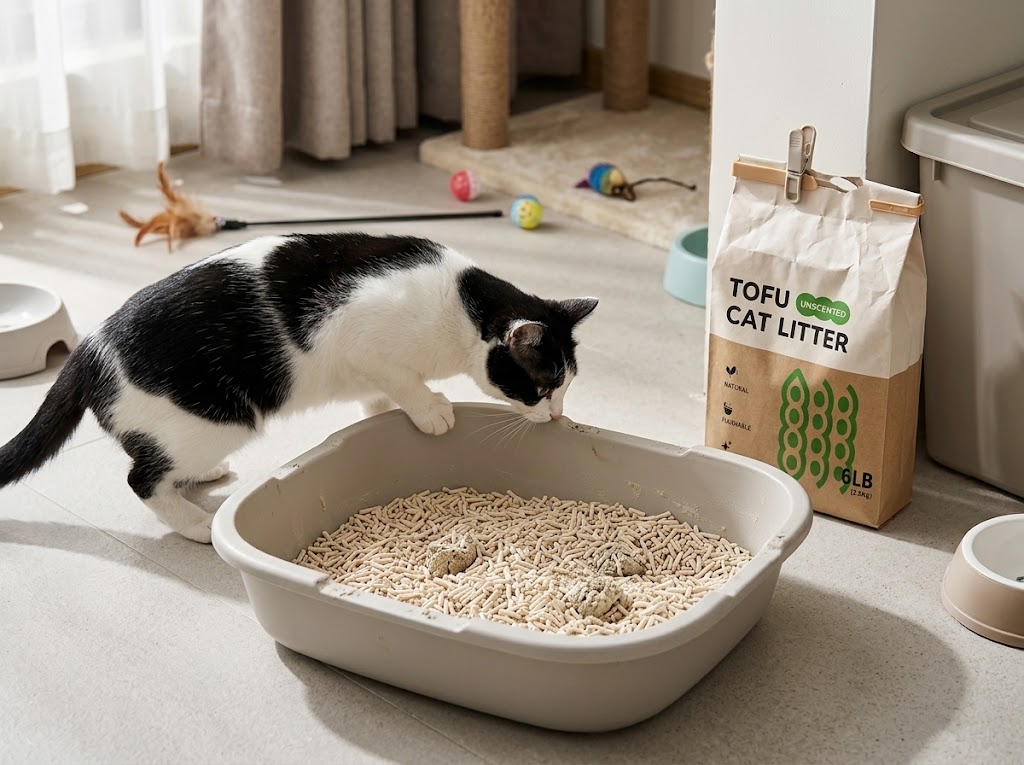
Head-to-Head Comparison: Performance, Cost and Channel Fit
The table below is a qualitative comparison of typical product behavior. Actual results vary by formula, grade and manufacturer, so treat it as a starting framework for specification discussions and not as test data.
| Dimension | Tofu Litter | Bentonite | Silica Crystal |
|---|---|---|---|
| Base material | Plant fibers and starches | Mined clay | Silica gel |
| Clumping | Yes, formula-dependent | Yes, strong | No (absorbs into beads) |
| Weight per pack | Lighter than bentonite | Heaviest | Lightest |
| Dust profile | Generally low, formula-dependent | Typically higher | Low |
| Customization range | Wide: pellet size, color, scent, pack format | Moderate: grading, scent | Limited: bead size, indicator additives |
| Raw-material exposure | Agricultural inputs | Mining and processing | Chemical processing |
| Unit price position | Mid to upper-mid | Lowest | Highest |
| Freight cost per use | Moderate | Higher due to weight | Lower |
| Best-fit channel | Eco/natural ranges, e-commerce, premium private label | Mass retail, price-led ranges | Specialty retail, premium niche |
| Main commercial risk | Formula consistency between batches | Weight-driven freight and dust complaints | Price sensitivity, shopper unfamiliarity |
Reading the Table as a Buyer
No type wins on every line. Bentonite wins on unit price and shopper familiarity. Crystal wins on weight and change interval. Tofu wins on the combination of lighter freight, plant-based positioning and the breadth of what you can customize. Which one “truly wins” for you depends on whether your range needs a price anchor, a premium niche or a natural-positioned mid-tier. Many retailers stock more than one.
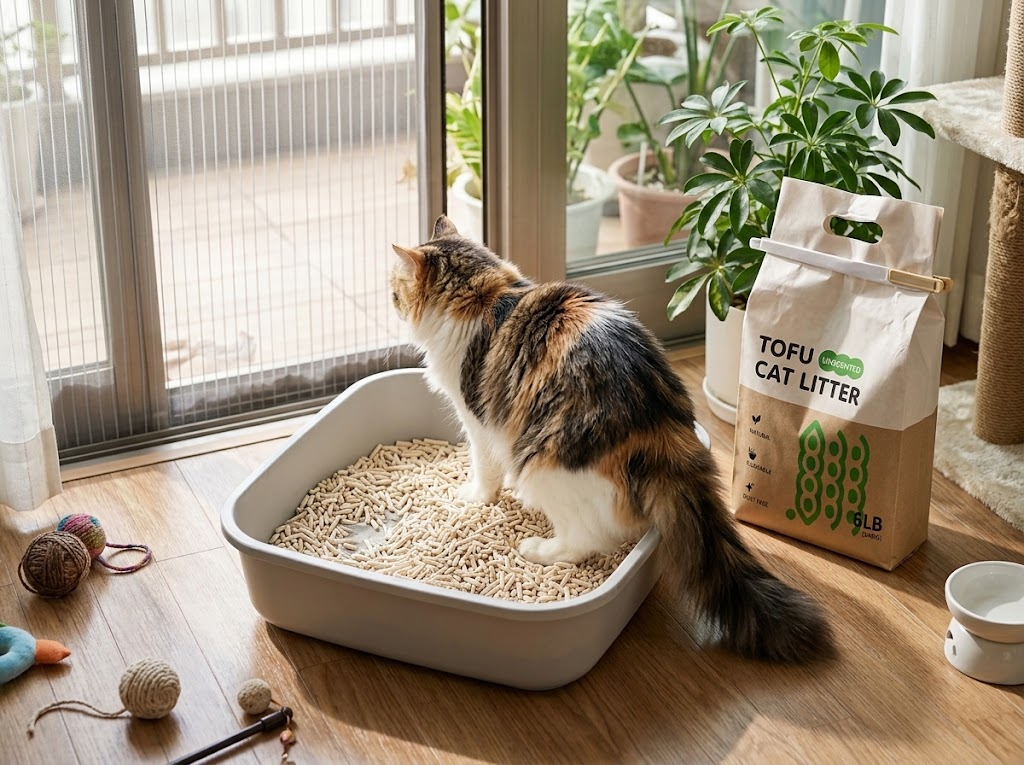
Where Tofu Litter's Formulation Flexibility Matters in Practice
Because tofu litter is extruded, a manufacturer can change variables that are fixed in a mined or gel product. Lolostar offers its tofu litter in colors including white, pink, green, yellow, purple, black and off-white, plus a gray-black version with activated carbon. Scent options include original, apple, lemon, coffee, rose, lavender, milk, green tea, peach, corn, mango, bubble gum and activated carbon. Standard pack sizes are 2.5kg (6L), 2.8kg (7L) and 7.5kg (18L), with custom sizes supported, and shelf life is three years.
For a brand owner, this means one base formula can support several SKUs without a separate development cycle each time. Packaging formats, including stand-up pouches, eight-side-seal bags, three-side-seal bags, flat vacuum bags, brick vacuum bags and cartons, can also be matched to the channel, whether that is shelf, online or bulk.
What to Evaluate When Comparing Suppliers Across Types
Whichever litter type you choose, the same questions separate dependable suppliers from risky ones:
1. Batch consistency: Particularly important for plant-based litters, where raw-fiber variation can change pellet density and absorption.
2. Dust and clumping testing: Ask what methods are used and whether results are available per batch.
3. Packaging integrity: Seal strength and moisture barrier affect damage rates in transit and, in turn, returns.
4. Customization capability: Whether pellet size, scent, color and packaging can be adjusted without large tooling or minimum-run penalties.
5. Supply stability: Raw-material sourcing for plant-based litters should be understood, since agricultural inputs can fluctuate.
A supplier’s ability to answer these specifically, with documents and not generalities, is usually a better predictor of low return rates than the litter type itself.
Which Type Fits Which Buyer
1. Price-led mass retail: Bentonite remains the practical anchor, with freight and dust management as the cost to plan for.
2. Premium or specialty niche:Crystal fits ranges where a long change interval is the selling point and the price tier supports it.
3. Natural, eco-positioned or private-label ranges: Tofu cat litter is the strongest fit, given the growth data above and the customization it allows. Hybrids suit buyers who want to move shoppers gradually from clay to plant-based formats.
For buyers building a plant-based tier, tofu cat litter offers the broadest room to differentiate, provided the supplier can prove consistency from batch to batch.
Suggested Meta Description: Compare tofu cat litter with bentonite and crystal litter on formulation, cost, and channel fit, with a buyer’s framework for OEM and private-label sourcing.
Lolostar: Your Trusted Tofu Cat Litter Supply Chain Partner
As a professional pet product manufacturer and supplier, Lolostar has deep expertise across the Tofu Cat Litter supply chain, with proven formulation technology and full OEM/ODM capability — supporting brand customers from spec customization and packaging design through to bulk delivery.
Our products meet EU REACH safety requirements (full SVHC compliance), and our factory holds ISO 9001 (Quality Management), ISO 14001 (Environmental Management), and ISO 45001 (Occupational Health & Safety) certifications (Certificate No.: 10426Q00119R001 / 10426E00081R001 / 10426S00081R001), meeting market access requirements for Europe, the US, Japan and other major pet product markets.
Start Your Tofu Cat Litter Product Line
If you’re looking for a reliable supply chain partner, or want to learn more about Tofu Cat Litter specifications and customization options:
📧 Email us at [email protected] to request product technical documentation and free test samples
Frequently Asked Questions (Q&A)
Q1: What quality tests should we request when comparing litter suppliers across tofu, bentonite and crystal types?
A1: Ask for dust content, clumping or absorption performance, moisture content and pellet or granule size distribution, along with the test method used for each. Request results per batch and not a single sample report. Methods and acceptance limits should be written into the purchase specification.
Q2: How does litter type affect return rates and claims?
A2: Returns usually trace back to a few causes: damaged or leaking packs, inconsistent particle size, excess dust and scent complaints. Heavy bentonite tends to raise freight-damage risk, while plant-based litters depend more on batch consistency. Packaging specification and incoming inspection often matter more than the litter type.
Q3: What should we look for in a tofu cat litter supplier for bulk orders?
A3: Look for documented raw-material sourcing, batch-level quality records, in-house control of pellet size and packaging, and a clear process for handling nonconforming lots. A factory audit or a third-party inspection before the first order is a reasonable due-diligence step.
Q4: What are the usual considerations for a tofu litter manufacturer OEM private label program?
A4: Define the formula, pellet size, color, scent and pack format first, then confirm artwork approval, packaging material specifications and who is responsible for labeling compliance in the destination market. Lolostar supports OEM and private-label customization across these variables.
Q5: What affects eco-friendly tofu litter MOQ requirements?
A5: MOQ is driven mainly by how many variables differ from a standard run: custom pellet size, scent, color and especially custom packaging with printed film. Standard-spec products generally have lower minimums than fully customized ones. Confirm MOQ per SKU and per packaging type with the supplier.
Q6: What drives premium tofu cat litter bulk pricing?
A6: The main drivers are raw-fiber cost, pellet size and scent or color additions, pack format, order volume and freight terms. Printed or vacuum packaging adds cost compared with plain bags. Request quotes broken down by pack format so the packaging component is visible.
Q7: What should we confirm about natural tofu cat litter export options?
A7: Confirm available pack sizes and palletization, container loading figures, shelf life, documentation for the destination market and lead times. Discuss labeling and import requirements with the supplier and your own compliance contact early, as they vary by country.
Q8: How should we evaluate supply stability for plant-based litters compared with mineral litters?
A8: Plant-based litters depend on agricultural inputs, so ask about raw-material sourcing, secondary sources and inventory buffers. Mineral litters depend more on mine and logistics capacity. In both cases, ask for on-time delivery history and capacity for repeat orders.
Articles on the Natural Soybean Tofu Cat Litter Series
1. What Makes Natural Soya Bean Tofu Cat Litter the Rising Star of Eco-Friendly Pet Care?
2. Tofu Cat Litter vs. Bentonite and Crystal Litter: Which One Truly Wins?(Current Article)
3. Is Soya Bean Tofu Cat Litter the Next Big Trend in the Global Pet Market?
4. Why Does Tofu Cat Litter Pricing Vary So Much Between Suppliers?
5. How Can Buyers Avoid Costly Mistakes When Sourcing Tofu Cat Litter?
6. From Soybean Waste to Clumping Litter: What Really Happens in Production?
7. Can Customized Formulas Solve Your Brand’s Cat Litter Pain Points?
8. What Quality Standards Separate Premium Tofu Cat Litter from the Rest?