What Should Buyers Check Before Sourcing a Multi-Level Cat Tree with Condo?
Cat furniture has moved from an accessory aisle item to a planned category in pet retail. Retailers and brands now treat it as a way to raise basket value, and one that is closely tied to how people think about indoor cat welfare. Veterinary bodies keep stressing that indoor cats need vertical space, places to hide and appropriate scratching surfaces. That guidance has shaped what end customers expect, and so what buyers have to specify. A multi-level cat tree with condo sits at the centre of this shift, because it puts several of those needs into one floor-standing unit.
For a buyer, though, the category is easy to misjudge. Two trees that look alike in photos can differ widely in board construction, stability, fabric safety and packing efficiency. Those differences decide return rates, compliance risk and margin. This article covers what the category is, which dimensions matter when comparing suppliers, and how the common formats trade off against each other.
Why Cat Furniture Keeps Gaining Shelf Space
Three drivers explain the category's steady growth, and none needs a headline statistic to be credible.
Welfare guidance is now mainstream. The Feline Environmental Needs Guidelines, published jointly by the American Association of Feline Practitioners (AAFP) and the International Society of Feline Medicine (ISFM), describe elevated observation points, hiding places and resting perches as core parts of a cat's environment. Well-designed vertical space and concealed retreats help reduce stress, which matters most in multi-cat households. A tree combining platforms, a condo and an upper perch maps directly onto this guidance.
Source: AAFP and ISFM, Feline Environmental Needs GuidelinesScratching management is a functional need. Cornell Feline Health Center identifies adequate, stable scratching surfaces as a necessary part of preventing destructive scratching on household furniture. A sisal post is therefore a functional component, not decoration. Buyers should treat post quality and anchoring as performance criteria.
Source: Cornell Feline Health Center, Feline Behavior Problems: Destructive BehaviorRetailers want differentiated, giftable, higher-ticket items. Cat trees are bulky and visible, and they photograph well. Integrated features such as a grooming arch give a retailer something to differentiate on without leaving the category.
What Is a Multi-Level Cat Tree with Condo?
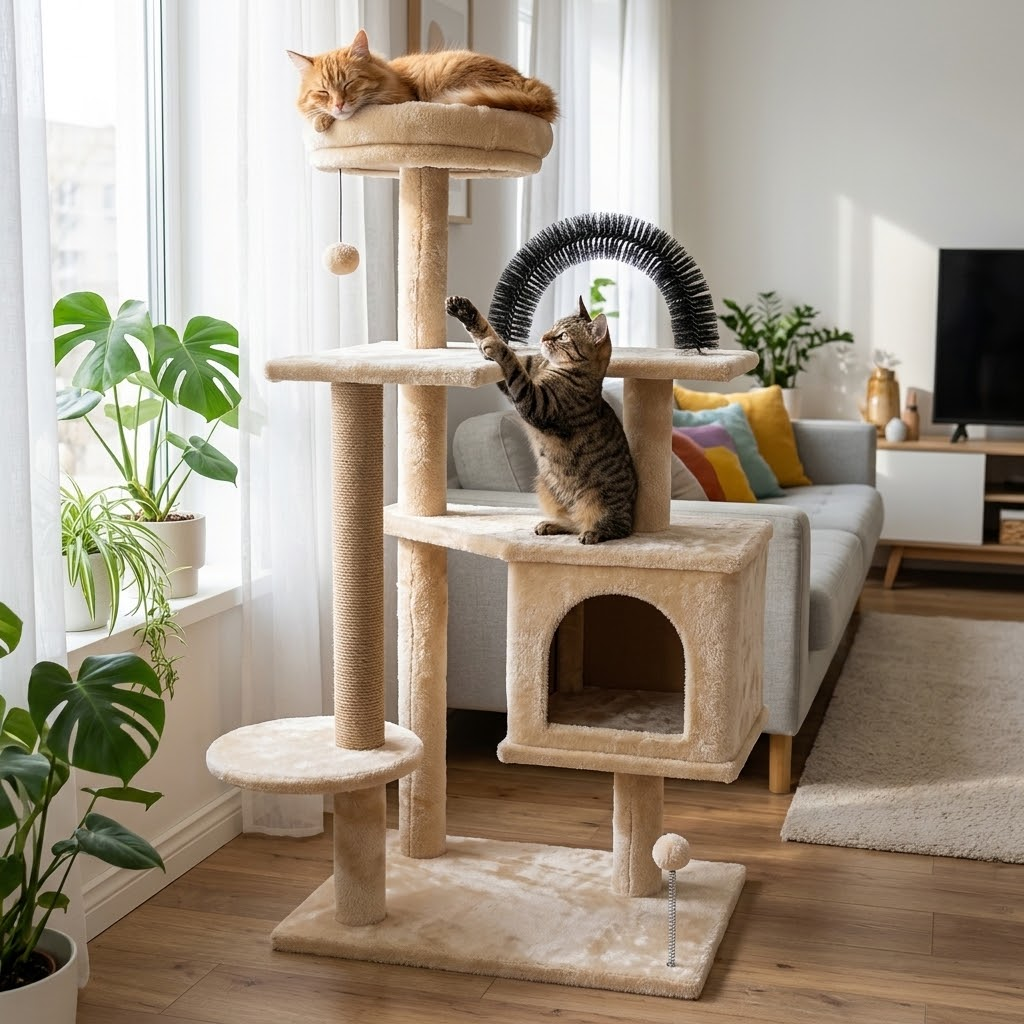
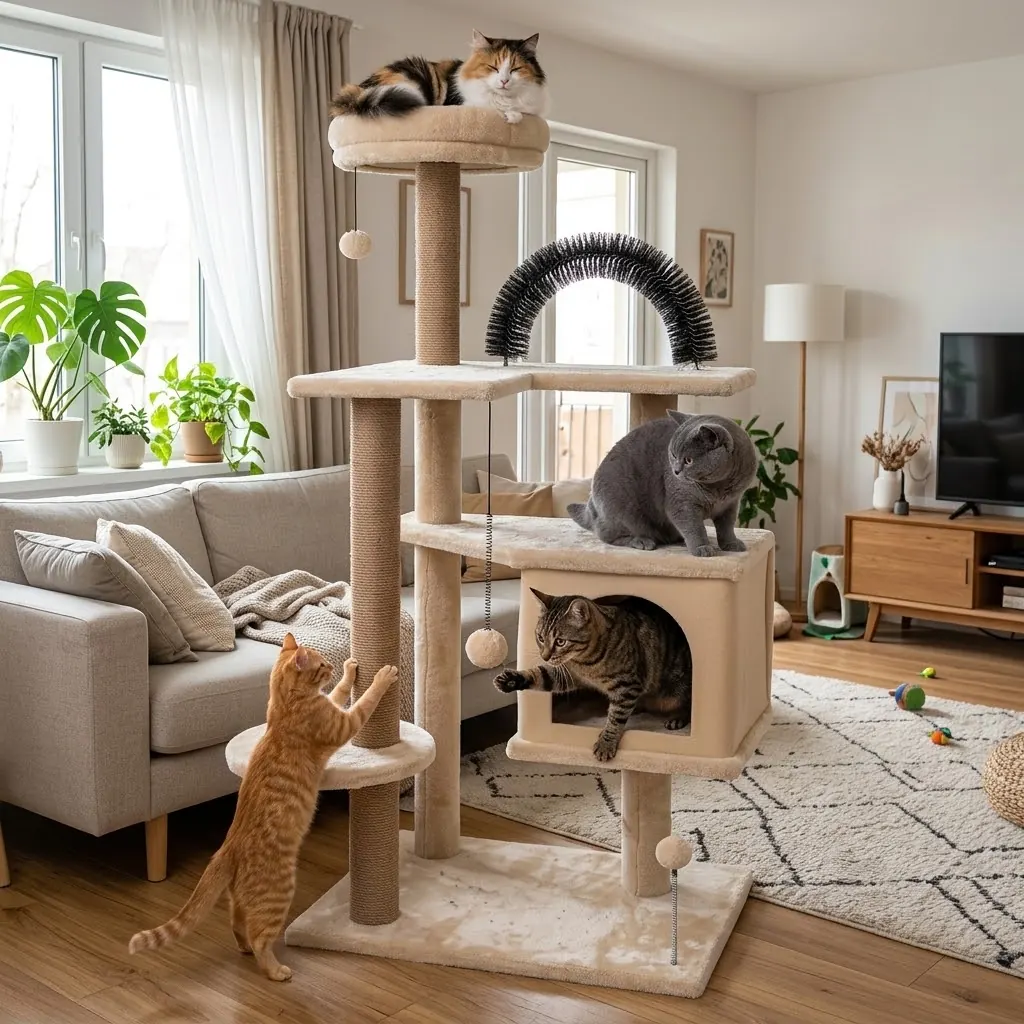
A cat tree is a freestanding vertical structure that combines scratching, climbing, perching and resting in one footprint. The "multi-level" label means at least two usable elevations, usually platforms or perches connected by posts. The "condo" is an enclosed or semi-enclosed hideaway, which supplies the concealed retreat that veterinary guidance emphasises.
The category splits into several formats:
Basic scratching posts and single-tier towers. Low cost, small footprint, limited behavioural coverage.
Multi-level trees with condo. The mainstream mid-range format, combining observation, hiding and scratching.
Tall floor-to-ceiling or large-format towers. More capacity, but higher freight cost and stronger stability demands.
Feature-integrated trees. A multi-level base with extras such as a grooming arch, hammock or play accessories.
Wall-mounted or modular systems. Space-efficient, but installation-dependent and a different buyer profile.
Within this range, the integrated multi-level format is where most programmes for brands and retailers are built. It offers enough features to justify its price point while staying practical to pack and ship.
The Dimensions That Matter When Evaluating Cat Trees
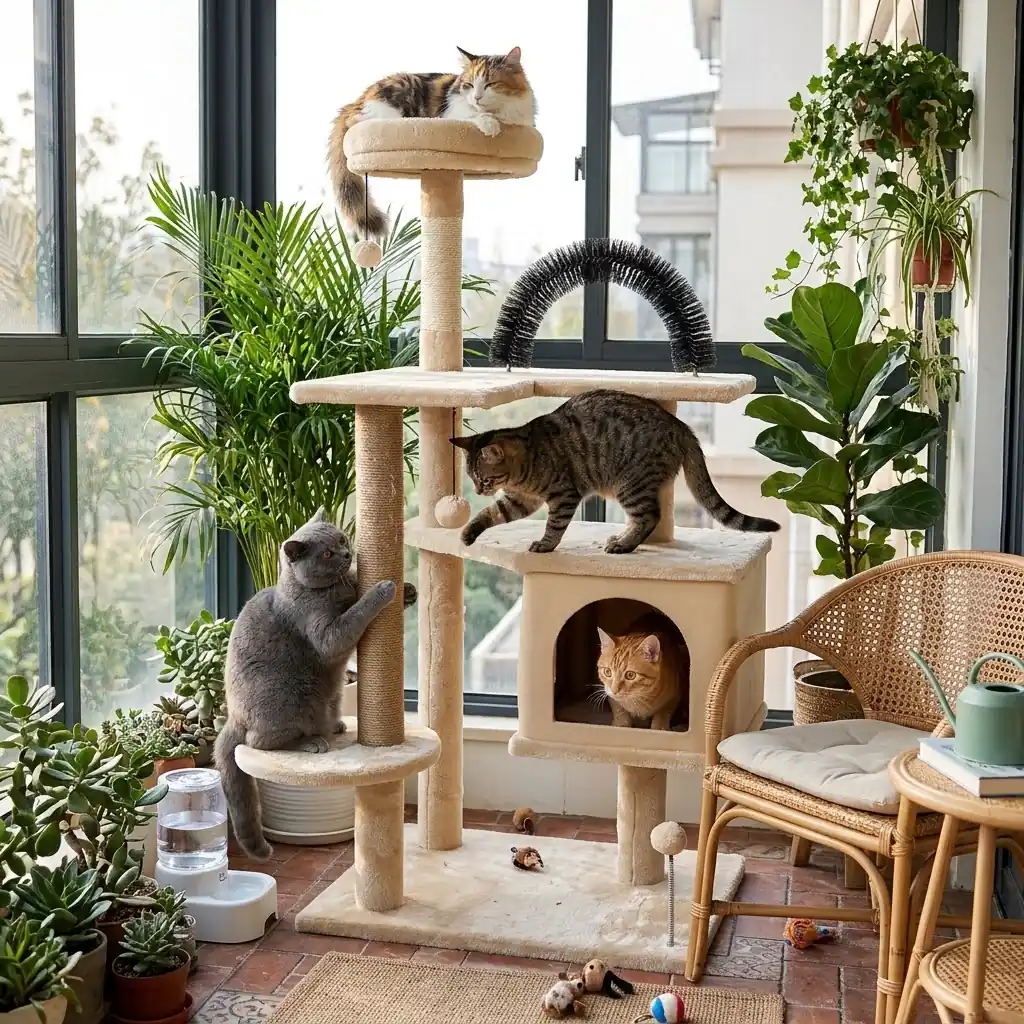
Buyers who compare only photos and price tend to find the problems after the first shipment. These are the dimensions that separate suppliers.
Structure and stability
Stability is the dimension most often traded away for cost. A broad, solid base, post diameter, the fixing method between posts and platforms, and the weight distribution of upper levels all affect whether a tree tips or wobbles. The usual trade-off: taller and lighter is cheaper to ship, while wider and heavier is more stable but costs more in material and freight. Ask for sample-based stability review, not just a drawing.
Board and core materials
Most trees use engineered wood for bases and platforms, and the exact board type, thickness, edge treatment and post core determine strength and durability. For North American exports there is also a compliance layer: composite wood panels such as MDF and particleboard must meet formaldehyde emission limits under US EPA TSCA Title VI. This is a mandatory requirement for legal retail and customs clearance, not a marketing option. Buyers should ask which board is used and request supporting documentation as a standard part of supplier review.
Source: US EPA, Formaldehyde Emission Standards for Composite Wood ProductsScratching surface
Natural sisal posts are the standard functional surface. What varies is post diameter, how tightly the sisal is wound and secured, and whether the post is solid enough to resist wobble under a pulling cat. A weak post fails the very behavioural need the product is sold to meet.
Fabric, padding and attachments
Plush fabric, padding and attachment hardware are the contact materials. The points to check are fibre choice, how fabric is fixed to boards, and whether edges and fasteners are enclosed. Loose staples or exposed hardware are a frequent source of complaints.
Functional add-ons
Grooming arches, hanging toys and hammocks raise perceived value but add failure points. Each add-on needs a defined specification, fixing method and cleaning access.
Packing and logistics
Flat-pack supply, carton dimensions and gross weight drive freight cost per unit. Because cat trees are voluminous, packing design often has as much effect on landed cost as ex-factory price.
How the Main Formats Compare
| Format | Behavioural coverage | Stability demand | Freight efficiency | Typical buyer use |
|---|---|---|---|---|
| Basic scratching post | Scratching only | Low | High | Entry-level, promotional lines |
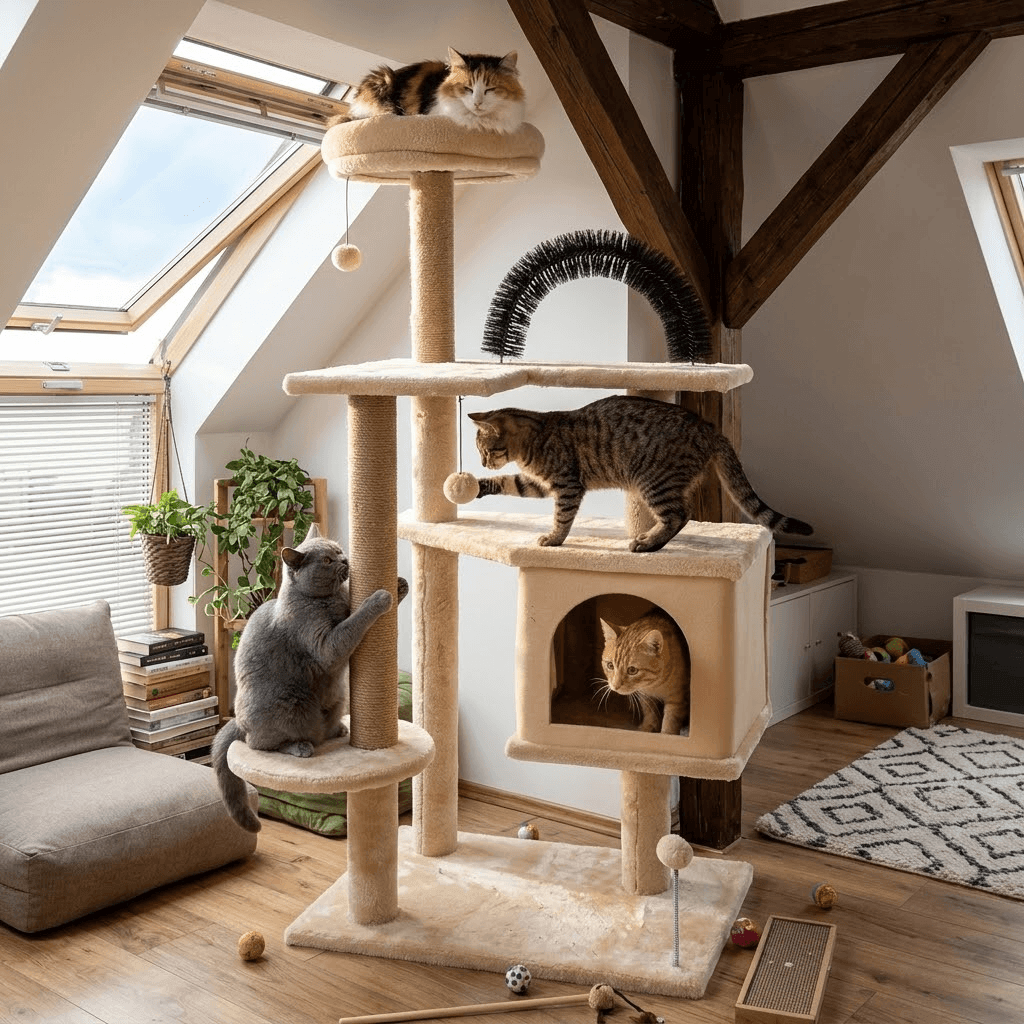
| Multi-level cat tree with condo | Scratching, perching, hiding | Medium | Medium to high (flat pack) | Core range for retailers and brands |
| Feature-integrated tree (grooming arch, play items) | Broad, plus grooming | Medium | Medium | Differentiated mid-to-upper range |
| Tall floor-to-ceiling tower | Broad, high capacity | High | Low | Premium or multi-cat positioning |
| Wall-mounted or modular system | Variable | Installation-dependent | High | Niche, space-conscious segments |
The pattern is consistent: each step up in coverage adds material, assembly complexity and stability requirements. The integrated multi-level format tends to give the best balance between range value and logistics.
Efficiency and Value: Where the Money Actually Goes
Unit price is a poor measure of value in this category. Three factors matter more.
First, failure and return cost. A tree that wobbles, sheds fabric or arrives with missing hardware generates returns and negative reviews that erase a small price advantage. Structural soundness and clear assembly instructions protect margin more reliably than a lower ex-works price.
Second, freight and storage efficiency. Flat-pack design and well-planned carton dimensions reduce cost per cubic metre. A slightly more expensive tree that packs better can land cheaper.
Third, range fit. A multi-level cat tree with condo covers several behavioural needs in one SKU, which simplifies assortment planning compared with stocking separate posts, beds and perches.
Buyers working with a supplier on a bulk order should also ask how specifications are locked. A design that is fixed in an approved bill of materials and drawing, and then checked on a packed sample, is far easier to reproduce consistently than one that is left loosely defined.
How Lolostar's Multi-Level Cat Tree Illustrates These Dimensions
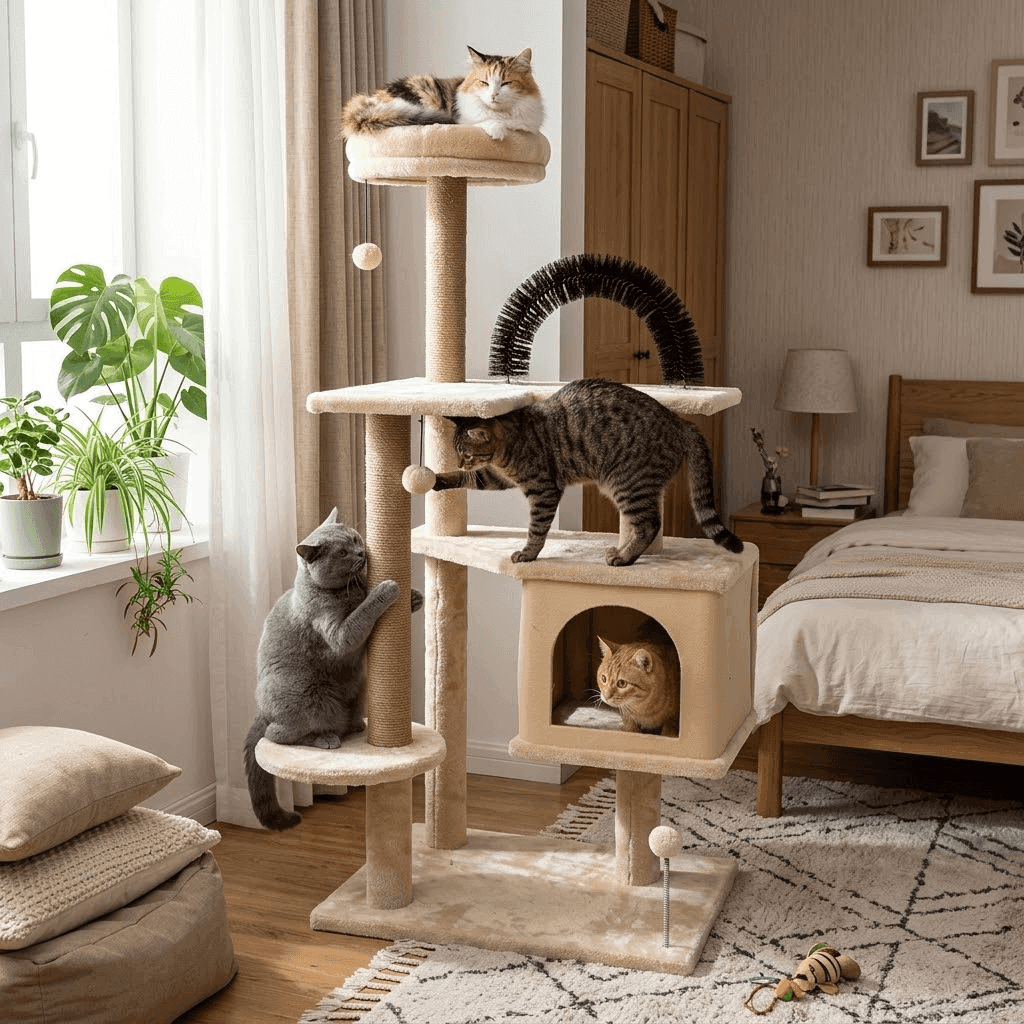
Lolostar's multi-level cat tree with self-grooming arch and cozy condo is an indoor model built to show how the dimensions above translate into a concrete specification. It measures 60 × 45 × 125 cm (23.62 × 17.72 × 49.21 in), and combines a private hideaway condo, observation platforms, an upper resting perch, play accessories and an integrated arch-shaped grooming brush. The base is a broad, solid layout carrying natural sisal posts, and its final structure and stability are reviewed on samples instead of being assumed from the drawing.
Two points are worth highlighting for buyers:
Specification control. Board type, thickness, edge treatment and post cores are defined in an approved bill of materials, and platform areas, condo entrance, post diameter and arch clearance are fixed in an approved drawing. For the grooming arch, the bristle specification, fixing method and cleaning access are agreed during development. That is the kind of documented process that supports consistent repeat orders and the board compliance checks described above.
Brand adaptability. The reference finish is a beige fabric with a dark grooming arch, and custom colours and logo branding are available. Flat-pack supply can be developed, with hardware, manual, carton dimensions and gross weight confirmed on the packed sample. For brands exploring private label cat furniture export programmes, this means the structure can be kept while the appearance and packing are adapted.
Choosing a Supplier: What the Evidence Should Look Like
A credible cat tree manufacturer should be able to show a defined bill of materials, sample-based stability review, board compliance documentation for the target market and a clear packing specification. If a supplier can only offer a photo and a price, the specification is probably not controlled. For a self-grooming cat arch manufacturer in particular, ask how the brush is secured and how it can be cleaned, because these are the details that determine whether the feature holds up in use.
The multi-level cat tree with condo remains the most practical anchor for a cat furniture range. It covers the behavioural needs that welfare guidance emphasises, it can be customised at the brand level, and it can be packed efficiently. Whether it performs well commercially depends on construction details that rarely appear in a product photo.
Lolostar: A specialist supply chain partner for multi-level cat trees featuring self-grooming arches and cozy cat beds
As a specialist manufacturer and supplier of pet products, Lolostar has deep roots in the supply chain for multi-level cat trees featuring self-grooming arches and cozy cat beds. With mature production processes and a robust quality control system, as well as OEM/ODM customisation capabilities, we provide brand clients with end-to-end support ranging from bespoke specifications and packaging design to bulk delivery.
Our products comply with the safety standards of the EU REACH Regulation (all SVHC requirements met), and our factory has been certified to the ISO 9001 Quality Management System, ISO 14001 Environmental Management System and ISO 45001 Occupational Health and Safety Management System (certificate numbers: 10426Q00119R001 / 10426E00081R001 / 10426S00081R001), and meets the market access requirements of major pet product markets such as Europe, the US and Japan.
Launch your product range of multi-level cat trees featuring self-grooming arches and cozy cat beds
If you are looking for a reliable supply chain partner, or would like to find out more about the specifications and customisation options for our multi-level cat trees featuring self-grooming arches and cozy cat beds:
📧 Email [email protected] to receive product technical documentation and free test samples
Frequently Asked Questions (Q&A)
Q1: What documentation should I request from a cat tree manufacturer OEM customization partner before approving a project?
A1: Ask for an approved bill of materials, a dimensioned drawing, board compliance documentation for your target market, and a packed sample. These show that the specification is fixed and can be reproduced across batches.
Q2: How do I evaluate a bulk order cat trees supplier's quality control?
A2: Look for sample-based structural and stability review, defined inspection points for fabric attachment and hardware, and a clear process for handling deviations. Ask whether inspection records are available per batch, and consider a factory audit or third-party inspection for first orders.
Q3: Which compliance requirements apply to cat trees exported to North America?
A3: Engineered wood components such as MDF and particleboard must meet formaldehyde emission limits under US EPA TSCA Title VI. Confirm with your supplier which board is used and request the supporting documents before production.
Q4: How should I think about MOQ and cost when looking for cat tree MOQ low cost options?
A4: MOQ depends on how much of the design is custom. Using an existing structure with changes limited to fabric colour and logo generally keeps tooling and setup costs lower than a new design. Ask the supplier which elements drive the MOQ in your case, and compare landed cost, including freight and packing, not just unit price.
Q5: What does private label cat furniture export involve beyond logo printing?
A5: It typically includes colour and fabric selection, packaging design, manual and hardware labelling, and market-specific compliance checks. Confirm who is responsible for each item and which parts are locked in the approved specification.
Q6: Why does packing design affect my sourcing decision?
A6: Cat trees are bulky, so carton dimensions and gross weight strongly influence freight cost per unit. A flat-pack structure verified on a packed sample reduces both shipping cost and transit damage risk.
Q7: What should I ask a self-grooming cat arch manufacturer about the grooming component?
A7: Ask for the bristle specification, how the brush is fixed to the arch, whether it can be cleaned or replaced, and what clearance the arch provides. These details are defined during development at Lolostar and should be confirmed on the sample.
Q8: Can Lolostar's multi-level cat tree be adapted to a brand's own colours and logo?
A8: Yes. The reference model uses a beige fabric with a dark grooming arch, and custom colours and logo branding are available. Final construction, packing and hardware details are confirmed on the approved sample.