Why is Cassava Cat Litter Becoming a New Choice in the High-end Cat Litter Market?
Introduction: A New Market Gap Created by Pet Consumption Upgrading
As pet health awareness rises, the global pet consumption market is undergoing a notable upgrade. For cat litter products, consumers are no longer satisfied with simply covering waste — they now demand more, such as “low dust to protect the respiratory tract” and “ultra-fast clumping for easy cleanup.”
Traditional cat litter often falls short in practice: bentonite litter struggles to fully eliminate mineral dust, while ordinary tofu litter tends to crumble and stick to the bottom of the litter box after prolonged use.
According to a global market report published by QYResearch, the global cassava cat litter market reached USD 810 million in 2024 and is projected to grow to USD 1.13 billion by 2031, at a compound annual growth rate (CAGR) of 4.9%. Against this backdrop, cassava cat litter — with its excellent physical properties and natural composition — is rapidly filling the demand gap in the premium cat litter market.
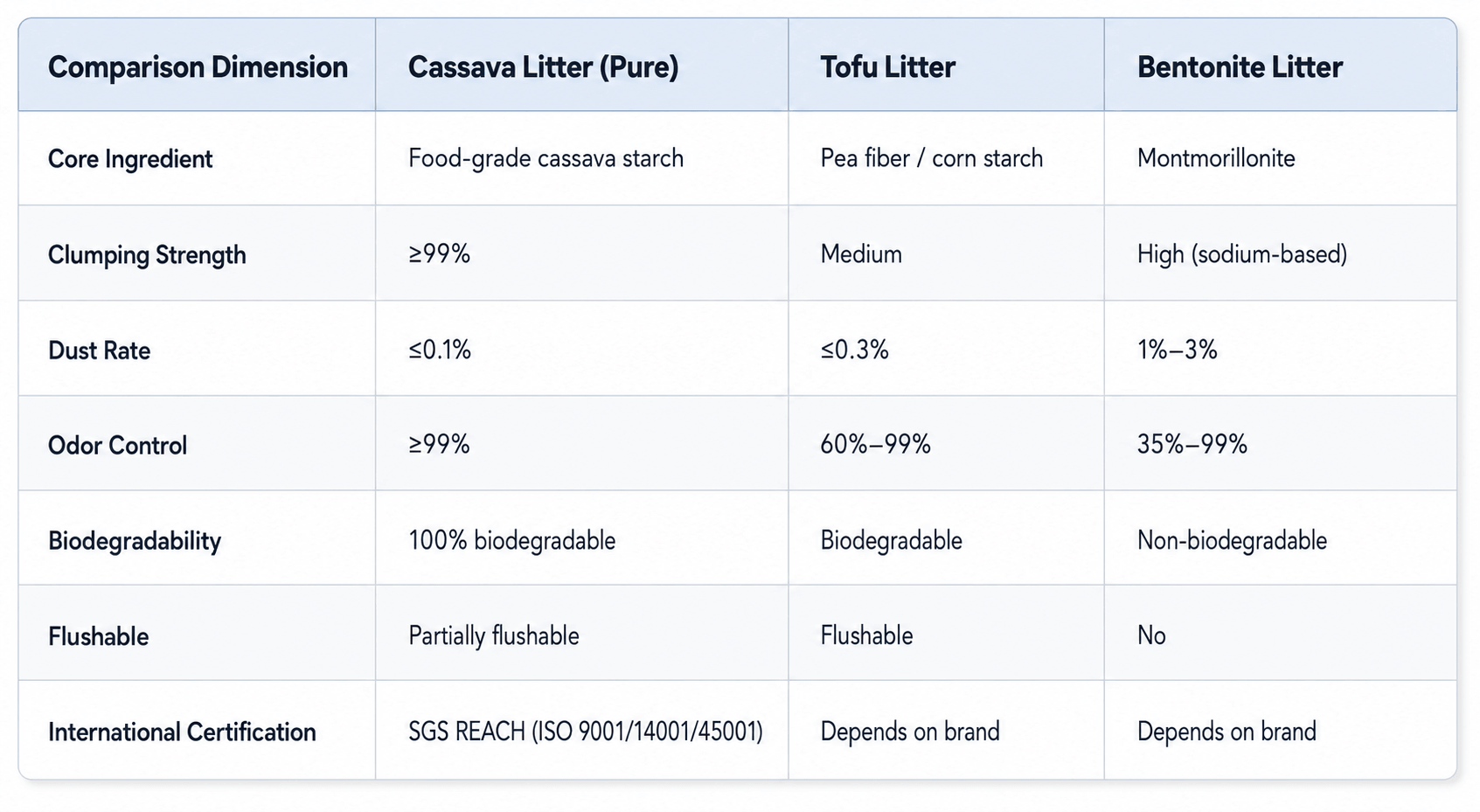
Among the main categories of cat litter, bentonite clumps quickly but generates heavy dust; tofu litter is flushable but tends to stick to the bottom; cassava litter, made from food-grade cassava starch as its core ingredient, achieves a strong balance across three dimensions: low dust, strong clumping, and biodegradability. In a comparative test of 40 cat litter products released by the Macao Consumer Council, cassava litter ranked among the top performers in clumping strength across all tested categories.
(Data sources: QYResearch Global Cassava Cat Litter Market Report; Macao Consumer Council Comparative Test Report on 40 Cat Litter Products)
What Is Cassava Cat Litter?
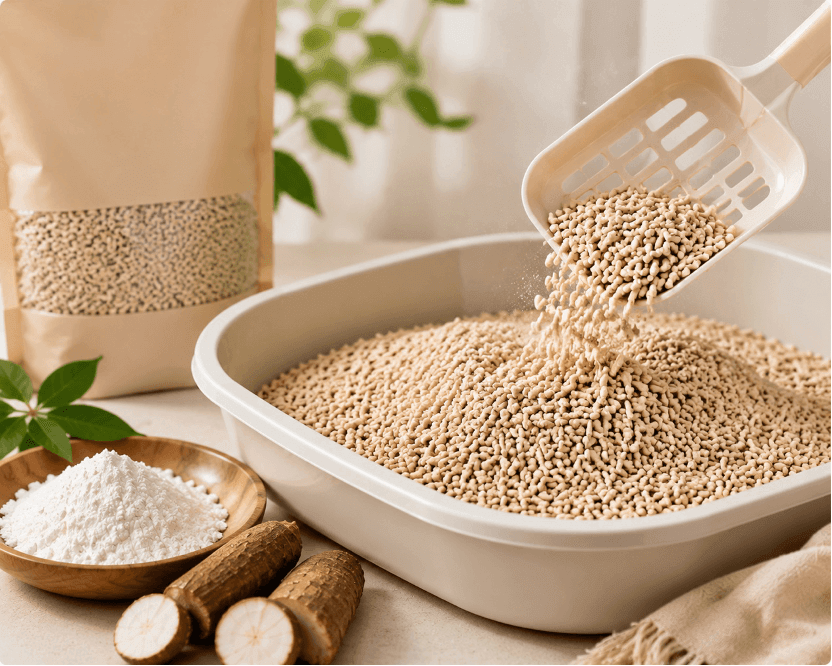
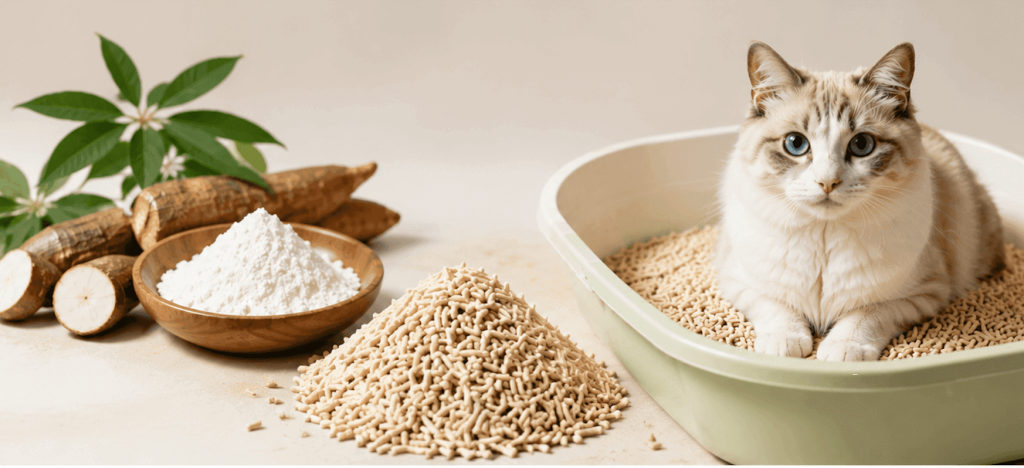
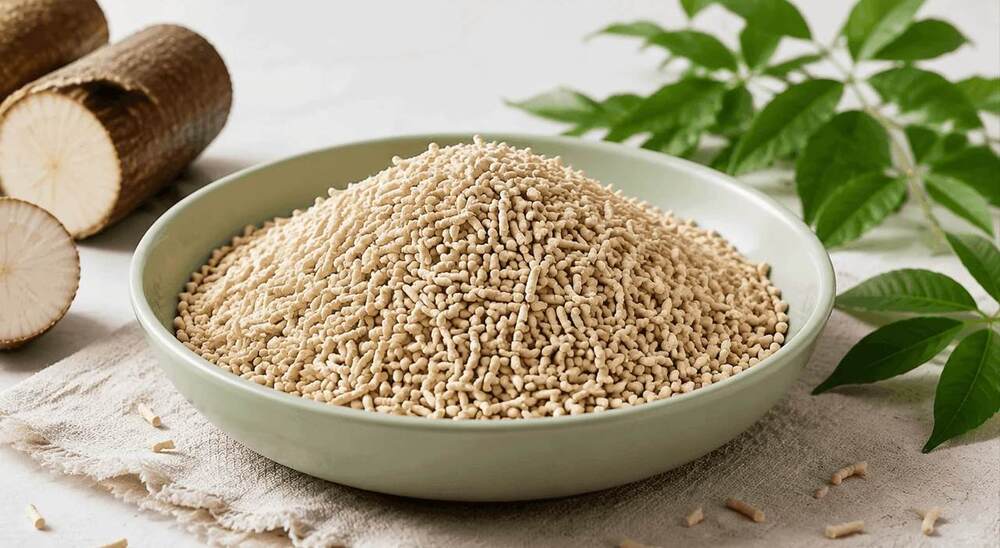
Cassava cat litter is a new type of natural cat litter made primarily from high-quality cassava starch and plant fiber, produced through a specialized granulation process. Its ability to stand out in the premium market comes down to the properties of its base material.
Cassava starch contains over 80% amylopectin — significantly higher than corn starch (about 70%) and potato starch (about 75%). This naturally high-molecular-weight structure rapidly absorbs water and swells upon contact, forming a three-dimensional network that delivers “instant water-locking, firm clumping.”firm clumping .
Currently, cassava cat litter on the market falls into two main types: pure cassava litter and blended cassava litter:
1. Pure Cassava Litter: Cassava starch is the core ingredient, typically making up 90% or more of the formula. It absorbs water faster and clumps more firmly, making it well suited to premium products with higher performance requirements.
2. Blended Cassava Litter: Cassava starch is combined with tofu litter (pea fiber), corn starch, and other ingredients, with cassava content typically ranging from 30% to 70%. While maintaining good clumping ability, it offers a cost advantage, and some formulations support a “flushable” design.
The two types differ in raw material cost, absorption rate, and flushability. Brand owners can select the formulation that best matches their target market positioning — whether premium all-plant-based or cost-effective composite (Formulation Optimization).
The following performance data complies with internationally recognized safety standards. The product has passed SGS EU REACH certification (Certificate No. QDF25-0085708-02), with all 251 Substances of Very High Concern (SVHC) screened and found compliant (<0.1%). Its food-grade raw materials pose no health risk to the digestive system even if accidentally ingested by kittens.
Four Core Performance Advantages: Why Cassava Cat Litter Performs Better
The underlying material properties of cassava litter determine its performance ceiling. The following four areas of measured data directly correspond to what cat-owning households care about most in daily use: how easy cleanup is, how noticeable odor is, whether dust harms the respiratory tract, and whether the litter holds up in humid environments.
1. Ultra-Fast Clumping: Solving the “Bottom-Sticking” Problem (Fast Clumping Technology)
Cassava litter’s excellent clumping ability comes directly from its high-amylopectin raw material. In actual use, high-quality cassava litter rapidly locks in liquid on contact and forms a firm clump.
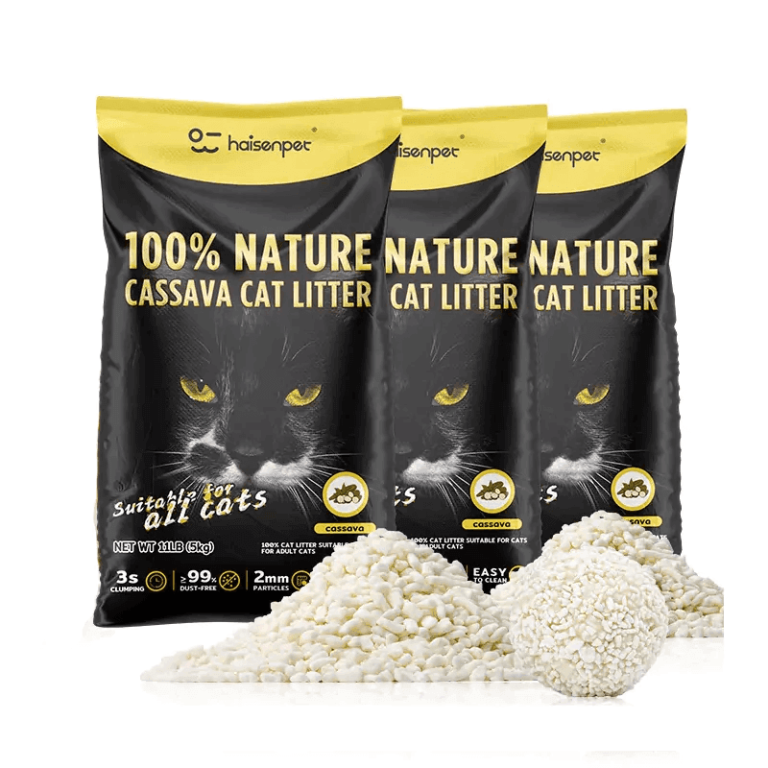
Clumping strength can reach 99.2%, meaning clumps resist breaking apart during scooping and disposal and can be removed intact. The Macao Consumer Council’s test report confirms this finding as well — cassava litter’s clumping strength ranked among the top performers across all tested categories. This ultra-fast absorption ensures urine is fully encapsulated before it reaches the bottom of the litter box, fully solving the sticking and hard-to-clean problems common with traditional litter.
2. Microporous Structure for Long-Lasting Physical Odor Control (Superior Odor Control)
Odor control is a key factor driving repeat purchases. During processing, cassava litter develops a rich microporous internal structure. This structure not only improves absorption but also physically traps odor molecules such as ammonia.
Odor control can reach 99.7% (physical adsorption, with no chemical fragrance), keeping indoor air fresh over the long term without relying on chemical fragrances to mask odor.
3. Low Dust for Respiratory Safety (Dust-Free Safety)
Multiple international veterinary studies indicate that long-term inhalation of mineral dust can trigger respiratory sensitivity or asthma in cats. Cassava litter is made through a plant-based extrusion process, contains no silica dust, and has a dust rate of ≤0.1%, meeting strict international market requirements for low-dust litter.
4. Moisture and Mold Resistance for Long-Term Use in Humid Regions (Moisture & Mold Resistance)
Cassava plant fiber has a dense, stable structure that absorbs liquid urine but does not absorb moisture from the air. During the rainy season or in humid coastal regions, ordinary tofu litter can become soft, sour-smelling, or even moldy once damp, whereas high-quality cassava litter stays dry and firm, resists spoilage, and remains odor-free — solving the problem of litter deteriorating in humid conditions.
Side-by-Side Comparison: Cassava Cat Litter (Pure) vs. Other Categories
Higher Usage Efficiency and Lower Cost Per Use
In the retail market, although cassava litter is typically priced higher per pack than ordinary products, its market acceptance continues to rise.
Absorption rate can reach 244.8%, far exceeding industry standard requirements. At the same weight, clumps are firmer and less prone to breaking apart, allowing more clean litter to be preserved with each cleanup.
For a single-cat household, one 4.2 kg bag of cassava litter (industry-rated volume of about 13.5 L) typically lasts 30–40 days, compared with 20–25 days for the same weight of traditional bentonite litter. Although the per-pack price is higher, when calculated as “cost per day of use,” cassava litter’s actual cost is roughly on par with mid-to-high-end tofu litter.
In practice, many users report that the most noticeable experience with cassava litter is “firm clumping — even stuck-on clumps can be scooped out intact.” Compared with traditional bentonite litter, there is almost no dust during use; compared with tofu litter, it is less prone to crumbling and mold. That said, some users note that because cassava granules are relatively light, cats can track litter out of the box after use, and recommend pairing it with a litter mat.
For brand owners and importers, this combination of high repeat purchase rate and high satisfaction offers an excellent foundation for building a premium brand image and improving profit margins.

Product Specification Reference
Common specification: 4.2 kg net content per bag, industry-rated volume of about 13.5 L, 24-month shelf life. Packaging size and design can be customized to brand requirements.
Lolostar: Your Professional Cassava Cat Litter Supply Chain Partner
As a professional pet product manufacturer and supplier, Lolostar has deep expertise across the cassava cat litter supply chain, mature formulation technology, and OEM/ODM customization capabilities — offering full-chain support from spec customization and packaging design to bulk delivery for brand clients.
The product meets EU REACH regulatory safety standards (full SVHC compliance), and the factory is certified to ISO 9001 (Quality Management), ISO 14001 (Environmental Management), and ISO 45001 (Occupational Health and Safety Management) (Certificate Nos. 10426Q00119R001 / 10426E00081R001 / 10426S00081R001), meeting market access requirements for Europe, the US, Japan, and other major pet product markets.
Start Your Cassava Cat Litter Product Line
If you’re looking for a reliable supply chain partner, or want to learn more about cassava litter specifications and customization options:
📧 Email [email protected] for technical product information and free test samples
Cassava Cat Litter Series Article Navigation
This article is the overview of the cassava cat litter series, helping you quickly understand product positioning, market opportunities, and procurement essentials.
We recommend bookmarking this series for easy reference to future articles.
Cassava Cat Litter Series Articles:
1. Why Is Cassava Cat Litter Becoming a New Choice in the Premium Cat Litter Market?(this article)
2. Why Is Cassava Mixed Cat Litter Emerging as the New Trend in Plant-Based Cat Litter?
3. Pure Cassava or Mixed Formula? Which Better Matches Your Target Market Positioning?
4. Demand Analysis for Plant-Based Cat Litter in European and American Markets
5. Cat Litter Cost Structure Analysis: How Different Formulas Affect Procurement Pricing
6. How to Choose a Reliable Plant-Based Cat Litter Supplier
7. Cat Litter Production Process and Quality Control
8. Private Label Cat Litter OEM Solutions