Different Structures, Different Markets: How Should You Choose a Dog Harness?
Most sourcing mistakes in this category start with treating the harness as one product with different colors. Dog harness types differ in material, in how load is distributed across the dog's body, and in where the leash attaches. Those differences determine unit cost, failure points, return risk and which retail channel a style suits. This article sorts harnesses by material and by functional positioning, then compares them on performance, cost and use case so buyers can match a structure to a market before requesting samples.
Why Structure Matters More Than Styling
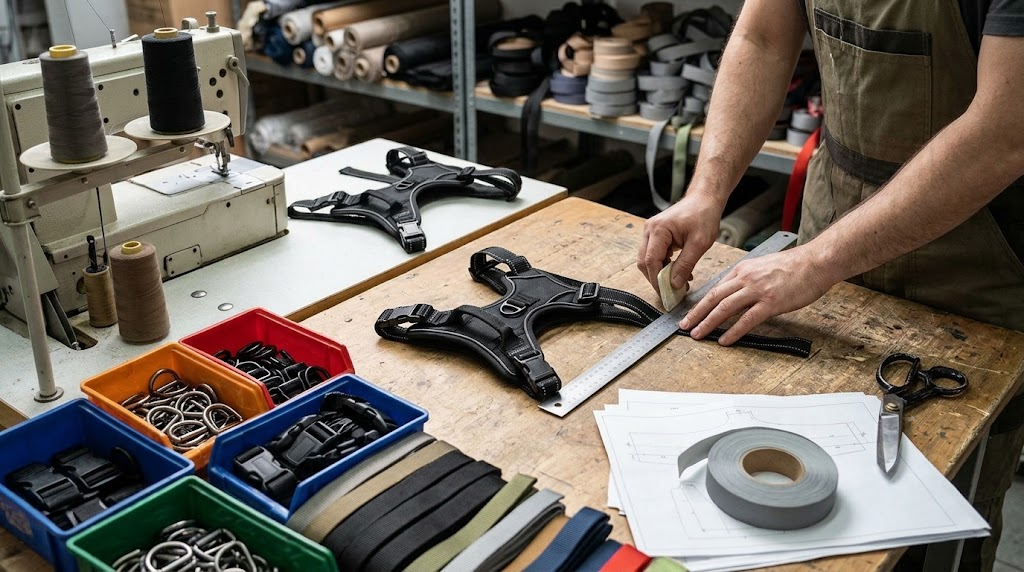
A harness is a load-bearing garment. Every pull, lunge or sudden stop travels through webbing, stitching and hardware before it reaches the handler's hand. A harness that looks identical to another on a product page can behave very differently in the field if the stitching is lighter, the buckle is weaker or the chest panel sits differently on the shoulder.
For brands and retailers, that shows up in two places: the return rate and the review profile. Failures rarely come from the fabric itself. They come from stitched load points, adjusters that slip and hardware that deforms. Choosing a structure is therefore a commercial decision as much as a design one.
Dog Harness Types by Material and Construction
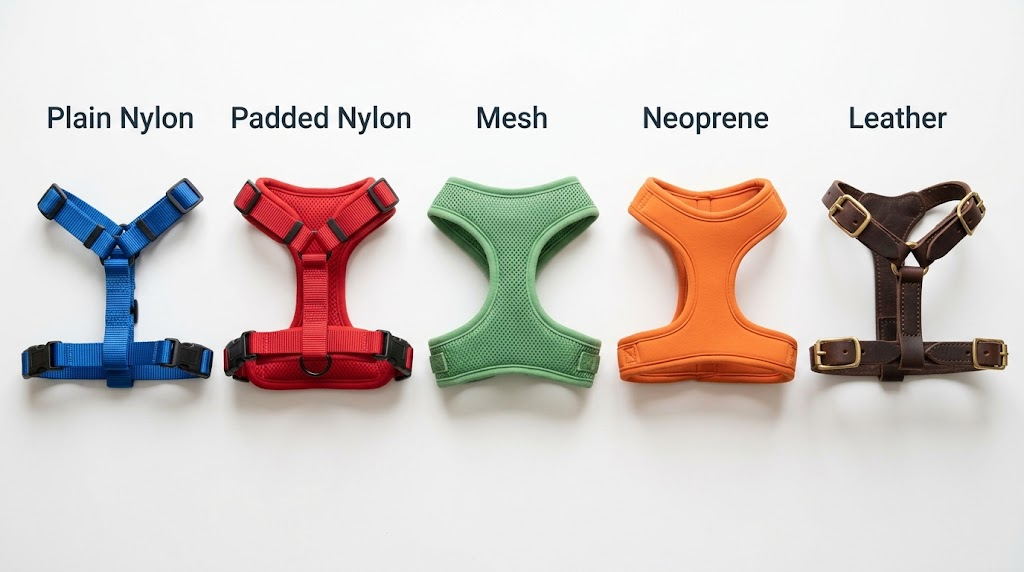
Material determines the price tier, the feel in hand and how much maintenance the end user will tolerate.
| Material / Construction | Performance Profile | Relative Cost | Typical Channel Fit |
|---|---|---|---|
| Nylon webbing, unpadded | Strong for its weight, quick-drying, easy to dye | Low | Entry-level lines, promotional programs |
| Nylon/polyester blend with padded, breathable lining | Good abrasion resistance, reduced rubbing on the chest and underarm | Low to mid | Mainstream pet retail, online brands |
| Mesh-panel, lightweight | Airflow and low weight, but less structural rigidity | Low to mid | Warm-climate and small-breed ranges |
| Neoprene or soft-shell padded | Cushioned, but heavier and warmer | Mid | Active and outdoor positioning |
| Leather or leather-trimmed | Distinct look, ages visibly, needs care | High | Boutique and gift-oriented lines |
Nylon and polyester dominate volume programs because they are consistent from batch to batch, take color well and tolerate frequent washing. Blending the two gives a webbing that resists abrasion while staying comfortable against the coat.
Leather works differently. It sells on appearance and perceived quality, but hide grade, tanning and edge finishing all vary, so consistency depends heavily on the factory. A buyer evaluating a leather dog harness manufacturer should ask how hides are graded, how edges are sealed and how stitching density is controlled at the buckle and ring attachments, since leather tolerates poor stitching worse than webbing does.
Dog Harness Types by Functional Positioning
Function is the second axis. It decides who the product is for and how it is merchandised.
Back-clip walking harness. The leash attaches between the shoulder blades. It is the default for everyday walks and suits calm dogs.
Front-clip no-pull harness. The ring sits on the chest, so pulling turns the dog sideways. It is positioned for training and strong pullers.
Dual-clip harness. Front and back rings on one product let the handler choose per situation, which broadens the audience.
Handle-equipped utility harness. A reinforced top handle gives close control near traffic or in crowds.
Reflective or night-use harness. High-visibility strips are added for early-morning and evening walks.
Most current products combine several of these. The useful question for a buyer is which function leads the positioning and which are secondary features.
What the Biomechanics Research Says About Chest Design
Functional positioning has a physical side that affects how a product can be described. Dr. Christine Zink, a sports medicine veterinarian, observed in early gait analysis that dogs wearing front-clip no-pull harnesses bore less weight on the forelimbs, with a restricted forelimb stride. When the attachment point moved to the back, the natural extended gait returned.
Source: Whole Dog Journal, The No-Pull Harness DebateA paper from October 2023 tested how chest geometry changes shoulder and elbow movement, comparing restrictive straight-front designs with non-restrictive Y-front designs. All harnesses affected gait to some degree. The Y-front kept elbow extension close to natural, at about 135.9°, while the straight-front gave the greatest freedom in shoulder extension, at 93.8°.
Source: ResearchGate, The Influence of Harness Design on Forelimb Biomechanics in Pet Dogs (October 2023)For buyers, two practical points follow. First, no chest design is neutral on every joint, so marketing copy that claims zero restriction is hard to defend. Second, a front attachment point has a gait trade-off that a back attachment point does not, which is a reason to offer both rings and let the user choose. Chest geometry and ring placement should be treated as specification decisions that you document with your supplier.
Side-by-Side Comparison: Performance, Cost and Use Case
| Type | Performance Strengths | Main Limitations | Cost Position | Best-Fit Use Case |
|---|---|---|---|---|
| Back-clip, padded nylon/polyester | Comfortable, simple, low failure points | No pull correction | Low to mid | High-volume everyday ranges |
| Front-clip no-pull | Steering control for strong pullers | Forelimb gait trade-off if used constantly | Mid | Training-focused positioning |
| Dual-clip with handle | Flexible control, one SKU for several needs | More hardware and stitching to control | Mid | Mainstream and mid-premium lines |
| Y-front / straight-front chest geometry | Different joint-freedom profiles (see data above) | Fit sensitivity across breeds | Low to mid | Fit-led or vet-channel positioning |
| Leather or leather-trimmed | Appearance, perceived quality | Higher care needs, higher cost, grade variance | High | Boutique and gift lines |
Cost tracks complexity, not just material. Each additional ring, buckle, adjuster and reinforced seam adds components, sewing operations and inspection points. A dual-clip harness with a handle and reflective trim costs more than a plain back-clip model in the same fabric, and the added cost is concentrated in the places where failures happen.
Where YUANFEI PET's Dual-Clip Harness Fits
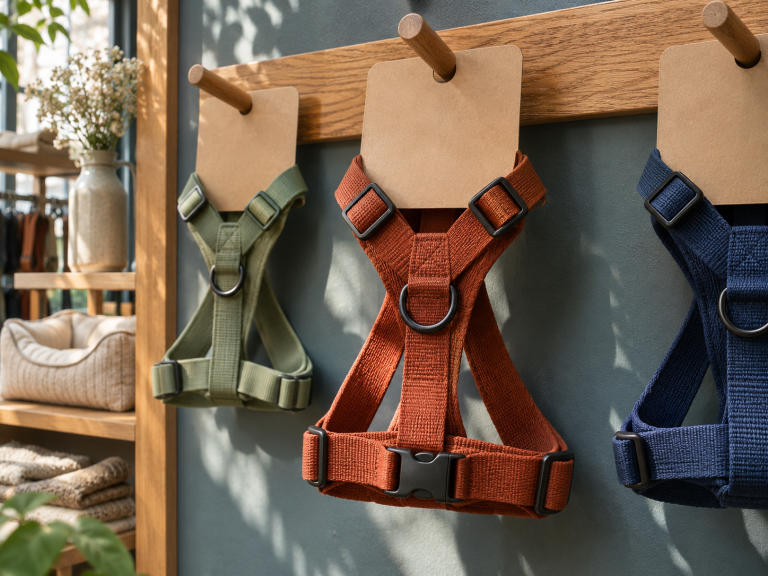
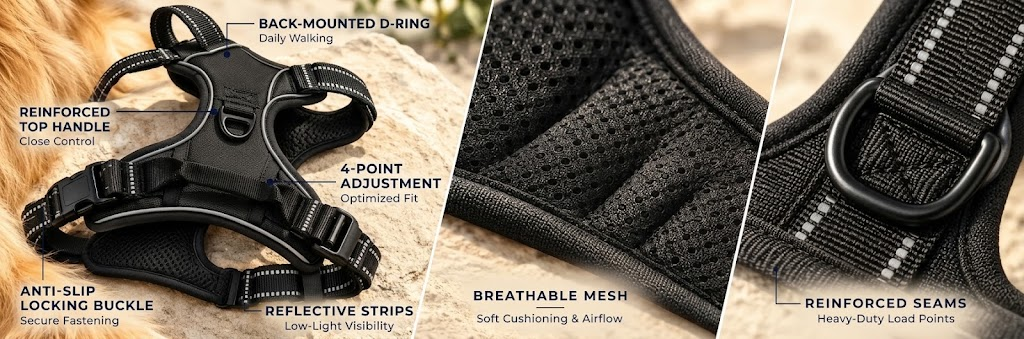
YUANFEI PET's multifunction no-pull harness follows the dual-clip structure. The body uses a high-strength nylon and polyester blend with a soft, breathable cushion lining against the skin. The leash rings, buckles, adjusters and handle all sit on heavy-duty stitched load points.
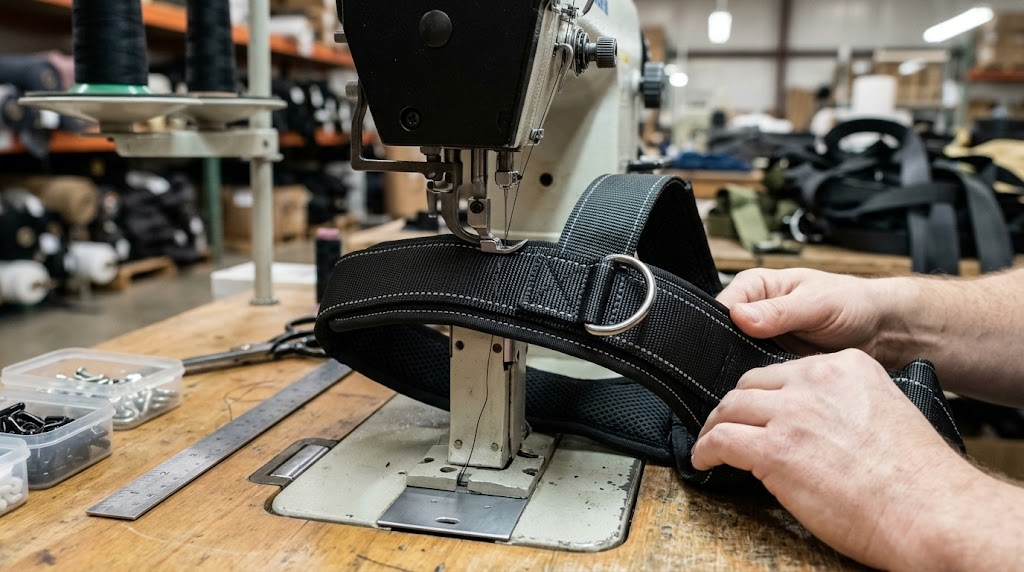
Two features carry most of its positioning. The first is the front-chest and back-mounted ring pair. The front ring supports training and steering, and the back ring covers everyday walking. Given the gait observations above, offering both lets the end user avoid using the front clip all the time. The second is the reinforced top handle, which gives close control at crossings or in crowds. It is also the part of the product that most directly depends on stitching quality.
Other specifications are straightforward. Four-point adjustment (two at the neck, two at the chest) fits a range of body shapes. Double buckles with an anti-slip locking system reduce loosening, and reflective strips add low-light visibility. Sizes are fully customizable, with neck girth, chest girth and webbing width set to the brand's requirements.
What Buyers Should Specify When Sourcing
Once the structure is chosen, the commercial terms matter. A few points apply to any supplier.
Customization scope. A genuine custom dog harness OEM program covers more than logos. Webbing hand-feel, hardware finish, buckle opening force, woven labels and packaging can all be adjusted. Confirm which of these are included and which carry tooling charges.
Private label depth. Dog harness private label production usually starts from an existing pattern, but a brand with its own fit standards may need a new pattern and grading set. Clarify early whether sizing is based on your measurements or the factory's.
Quantity structure. Dog harness bulk order options typically depend on how many colors, sizes and hardware variants are in the order. Minimums tend to be driven by webbing dye lots and hardware tooling. Splitting volume across fewer colors usually gives more flexibility than fewer sizes.
Supplier capability. A premium dog harness supplier should be able to show load-point stitching methods, incoming hardware checks and finished-product inspection records. Ask to see how seams at rings and handles are made, since those are where returns originate.
Matching Structure to Market
Volume retail and marketplace brands generally do best with padded nylon/polyester back-clip or dual-clip designs. These are consistent to produce and carry manageable failure risk. Training-oriented and specialty retailers can support front-clip positioning, provided the product descriptions are honest about the gait trade-off. Boutique channels can carry leather or leather-trimmed styles if they accept higher cost and tighter finishing control.
Before you finalize a range, compare dog harness types on three questions: where does load concentrate, what does each added feature cost in inspection effort, and does the stated function match what the research supports? A range built on those answers will be easier to defend with customers and easier to keep stable across production batches.
YUANFEI PET: Your Trusted Dog Harness Supply Chain Partner
As a professional pet product manufacturer and supplier, YUANFEI PET has deep expertise across the Dog Harness supply chain, with mature production processes, quality control systems and full OEM/ODM capability — supporting brand customers from spec customization and packaging design through to bulk delivery.
Start Your Dog Harness Product Line
If you're looking for a reliable supply chain partner, or want to learn more about Dog Harness specifications and customization options:
📧 Email [email protected] for technical data sheets and free test samples.
Frequently Asked Questions (Q&A)
Q1: How do I evaluate a supplier's quality control for harness load points?
A1: Ask for documentation of the stitching method at rings, buckles, adjusters and handles, and for records of in-process and final inspection. Request a sample and test it yourself by loading the hardware and seams, then inspecting for deformation or thread failure. A supplier should be able to explain what happens to a lot that fails inspection.
Q2: Which harness features most influence return rate?
A2: Return risk concentrates in buckles that slip or crack, adjusters that loosen under load, stitching that unravels at stress points, and poor fit across breed shapes. Each added component creates another potential failure point, so a feature-heavy design needs tighter control at those points.
Q3: What should I look for in a leather dog harness manufacturer?
A3: Look for consistent hide grading, sealed or finished edges, and stitching density at metal attachments. Ask how color and thickness are kept consistent across batches, because leather varies more than webbing does.
Q4: What does a custom dog harness OEM program typically include?
A4: Scope varies by factory, but it commonly covers webbing choice, hardware finish, logo labels, color matching and packaging. Pattern changes and new hardware tooling may be quoted separately, so confirm exactly what is included before approving samples.
Q5: How are dog harness bulk order options usually structured?
A5: Minimums are usually set by webbing dye lots, hardware tooling and the number of size and color variants. Discuss your variant plan early, as consolidating colors often reduces minimums more than reducing sizes.
Q6: How can I tell whether a premium dog harness supplier is actually reliable?
A6: Check for consistent sample-to-production results, clear communication on lead times, and willingness to share inspection records. A factory audit, either on-site or via a third party, adds confidence, especially for private label programs where your brand carries the liability.
Q7: How should dog harness private label production be scoped to avoid fit problems?
A7: Provide your own measurement chart and target breed profiles, then approve a graded sample set before production. Fit issues are far cheaper to resolve at sample stage than after bulk production.
Q8: Can we make claims about gait or "no restriction" on a front-clip harness?
A8: Be cautious. Published observations show that front-clip designs can reduce forelimb weight bearing, and that all harness chest designs affect gait to some degree. Claims should be limited to what you can support, and offering a back-clip ring as an alternative is a reasonable way to address the trade-off.