Plush, Rope or Molded Dog Toys? How to Match Construction to Your Retail Brief
Send “a dog toy in our brand colors” to three factories and you may get back a sewn character, a knotted rope and a molded bone. Three different products, each with its own development path and sample risks. Choosing among constructions for private label dog toys costs almost nothing at the start and is expensive to undo once samples and packaging are underway.
This guide to private label dog toys works through one sample brief, compares the three constructions, shows what each one commits you to, and ends with what to put in your sample request.
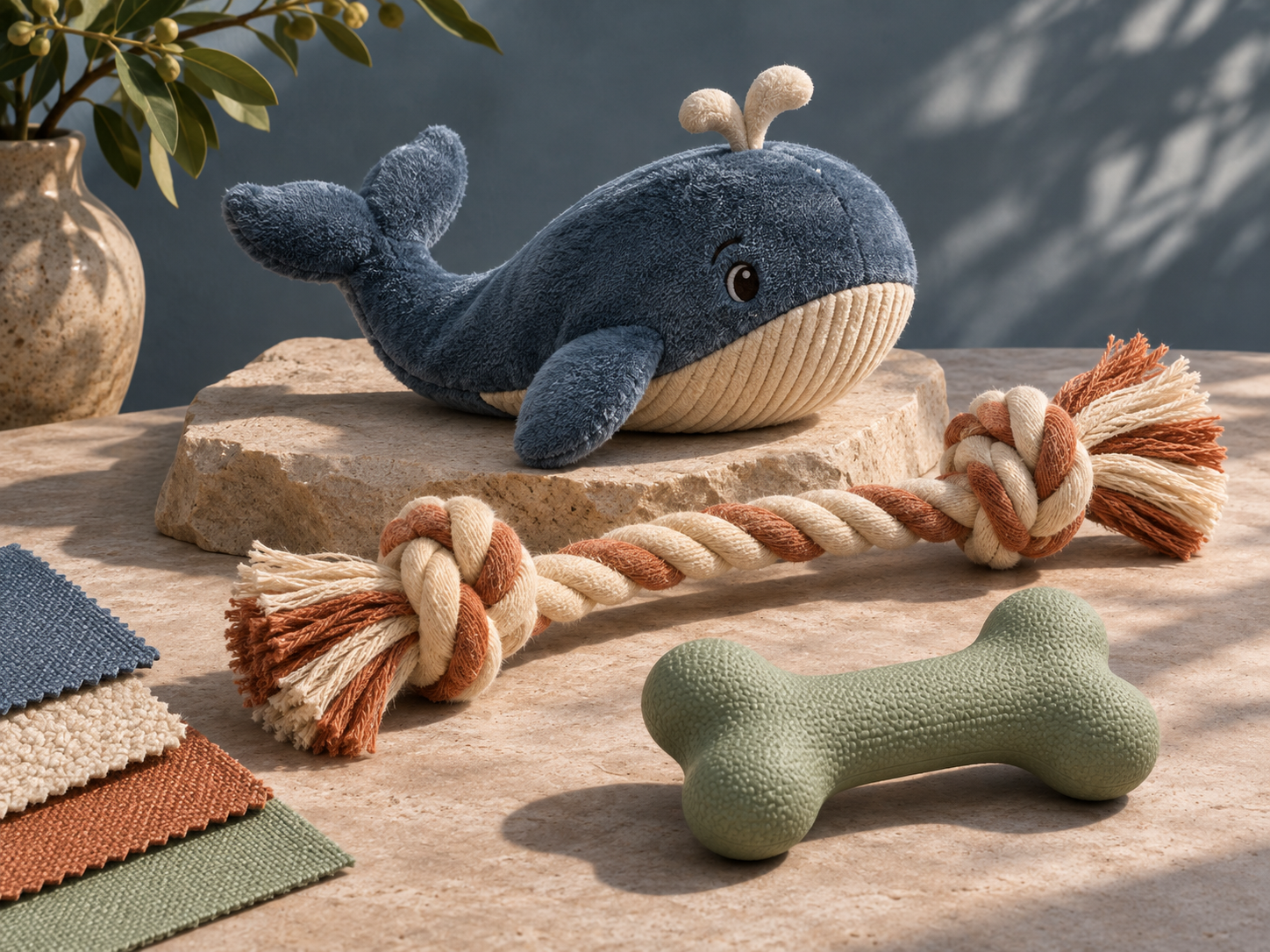
One shelf slot, three ways to fill it
The sample brief: a regional pet retail chain wants one year-round private-label toy for its hanging everyday-toy bay. The team wants a recognizable character, interesting texture and supervised interactive play. The plan is 3,000 units in one size and two colorways (1,500 each), one construction, in a packaged display no larger than 360 mm high × 180 mm wide × 90 mm deep. They would rather start from an existing platform than pay for an exclusive molded shape.
The three candidates below compete for that one slot; they are not a three-SKU range. All figures in this article, including sizes, weights and costs, are example targets for sampling and quoting. They are not catalog specs, quotes or YuanFei Pet minimums. Weights include every toy component and exclude retail packaging.
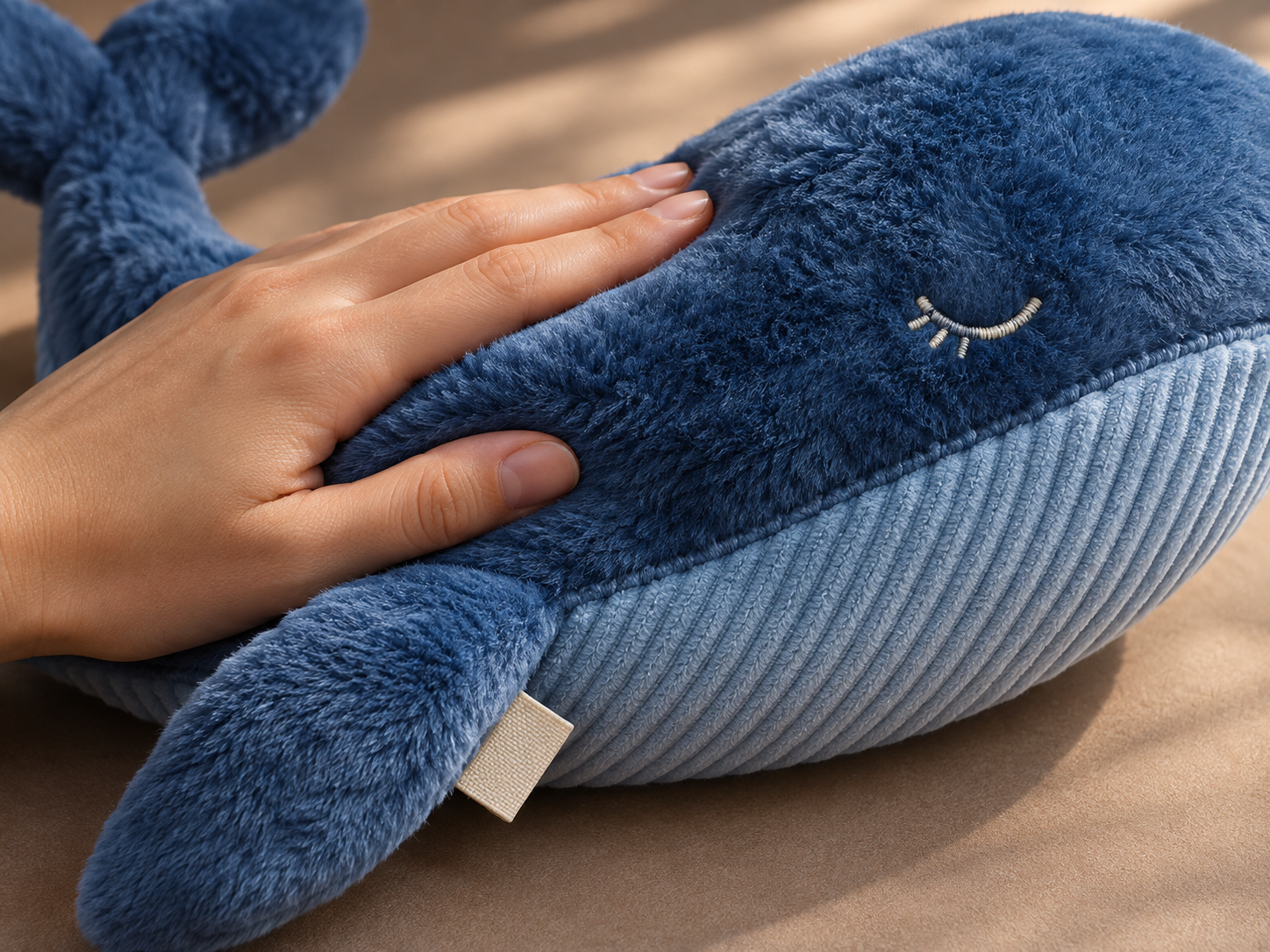
Sewn plush character. A 240 × 130 × 70 mm filled character at about 95 g, with embroidered facial details, a small woven brand label and one squeaker inside. It gives you carry-and-squeak play and the strongest character photography of the three. Settle these up front: outer fabric and backing, amount and placement of filling, seam layout, squeaker location, color references and label position. Keep the body plain at first, and add a tug loop only if the play brief calls for one. The silhouette can change through pattern revisions without a body mold, but every extra panel, appendage and assembly step adds sewing work. On the first sample, check the shape and hand-feel, confirm the seams hold the filling in and the squeaker stays put, then measure the packed unit.
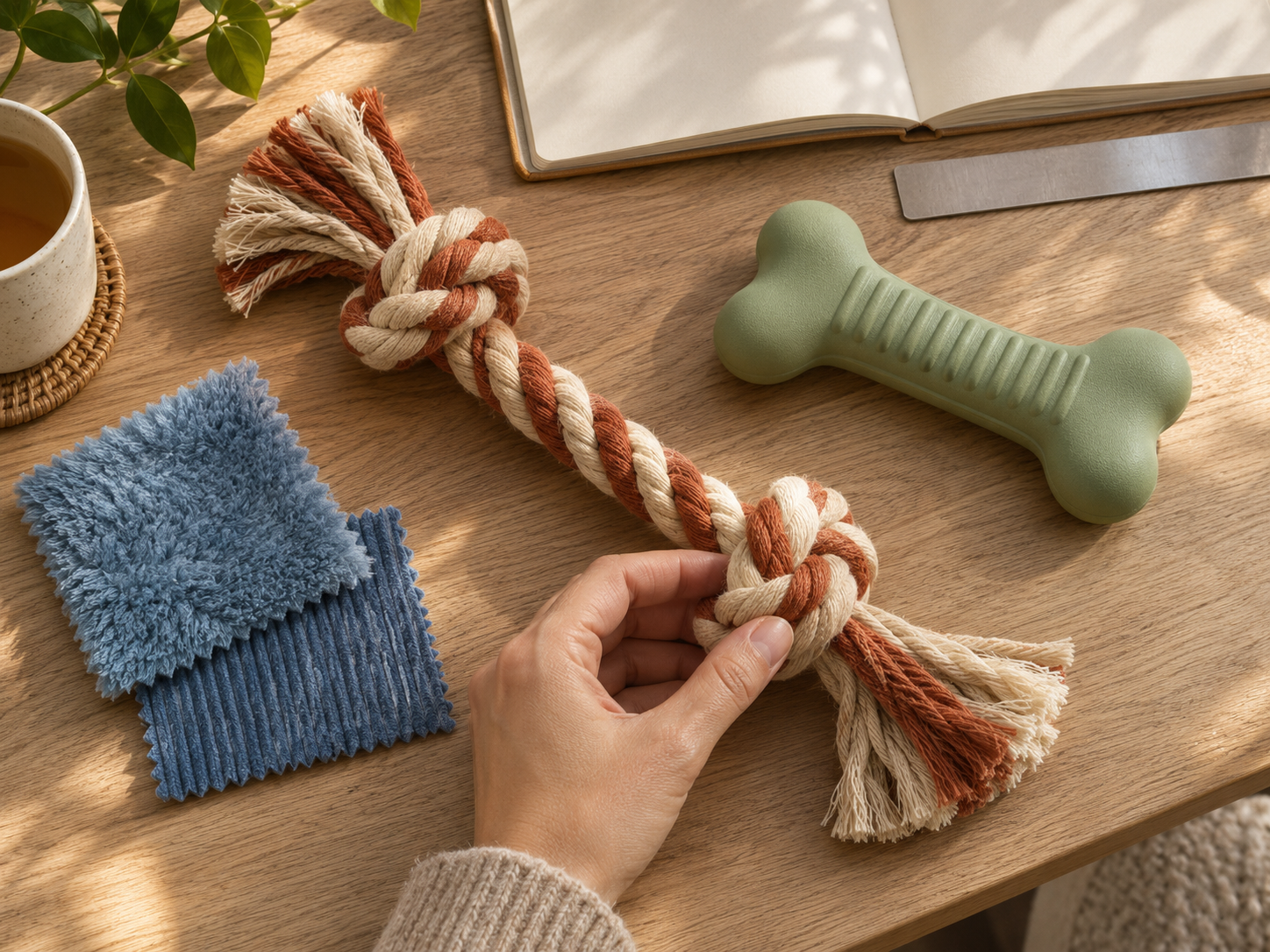
Braided, knotted rope. A two-knot tug, 300 mm end to end including tails, with a rope body about 18 mm thick (measured between the knots, without squeezing), roughly 150 g, in a two-color braid on a branded hang card. Settle the fiber blend (you can’t tell composition by looking), braid construction, knot position and tightness, tail length, color layout and how you will measure it. The simple geometry makes an easy-to-understand tug product. The trade-offs: limited character expression, and custom yarn colors or attachments that complicate purchasing and assembly. On the sample, look for knots that shift, ends that unravel, loose fibers, color transfer, and how the card is attached.
Molded TPR shape. A 150 × 65 × 35 mm textured bone at about 100 g, with no sound component, in one compound and two colorways on a branded card. “Molded” describes how the toy is made, not what it is made of. TPR, natural rubber and nylon perform differently, and a harder formulation is not automatically a better toy. Settle the compound and grade, target feel, geometry and wall thickness, surface texture, parting line and finish, and any color or logo changes. If an existing mold fits your idea, a color-and-pack launch may be possible (our TPR bone is a live reference). A proprietary silhouette or molded logo may mean modifying the tool or cutting a new one. On the finished sample, judge the material feel, flex, tear behavior, surface finish and any protrusions.
One thing to avoid reading into these numbers: weight says nothing about durability, and two toys of equal weight are not equivalent just because the scale agrees.
For this brief, start with plush
The buyer’s top two priorities, a recognizable character and tactile appeal, are what a sewn body does best, and the shape can keep evolving through pattern revisions without any tooling. YuanFei Pet’s shark plush shows the approach: a sewn character with ribbed, textured areas and a squeaker. Its tail loop is a good example of an optional extra. It adds an assembly step, so decide early whether the play brief really needs one.
Change the main play goal and the answer changes
The recommendation above follows from the priorities in this brief. A different brief points somewhere else:
| If the main goal is… | Start with | Investigate first |
|---|---|---|
| Character and carry-and-squeak play | Sewn plush | Seam strength, squeaker retention |
| Two-way tugging | Braided rope | Knot movement, unraveling, loose fibers |
| A quiet, textured product | Molded TPR | Compound, geometry, surface finish |
| An ownable, custom shape | Molded TPR with a proprietary mold | Tool ownership and cost (see below) |
Start with one simple construction. Hybrids, such as rope sewn into plush or a molded insert in rope, create a join that needs its own retention checks, and that makes the first concept harder to quote and sample.
What each route commits you to
Each construction asks for a different kind of commitment before you see a finished toy.
Custom plush dog toys need no body mold, but they need development time. Expect patternmaking, fabric and filling choices, a woven label and a few rounds of sample revisions. Labor grows with every panel, appendage and assembly step, so plush is usually the most hands-on of the three to produce. Ask each quote to state how many sample rounds it includes.
Rope dog toys need neither a mold nor a pattern, and their commitments sit in materials. Fiber blend, custom-dyed yarn and attachments are where purchasing minimums and cost creep in. If the brand colors are fixed, ask early whether yarn can be matched to your references and at what minimum per color.
Molded TPR dog toys come down to a tooling decision. Here is what that decision looks like for the bone, using example figures. Both routes include the finished toy and the same retail card. Neither includes freight, duties, taxes or testing.
| Route | Packed-unit cost | One-time tooling | At 3,000 units | At 12,000 cumulative units |
|---|---|---|---|---|
| Existing mold, color and card changes | $1.80 | $0 incremental | $5,400 ($1.80/unit) | $21,600 ($1.80/unit) |
| Proprietary mold | $1.55 | $2,400 | $7,050 ($2.35/unit) | $21,000 ($1.75/unit) |
At 3,000 units, the proprietary mold costs $1,650 more. It saves $0.25 per unit, so the two routes break even at 9,600 units ($2,400 ÷ $0.25). At 12,000 units the proprietary mold comes out $600 cheaper, as long as the same tool serves an unchanged design and the per-unit saving holds. That saving is an assumption in this example, not something a custom mold delivers automatically. And a break-even point tells you about money, not demand: 9,600 units only matters if you expect to sell them.
Two cautions on the table. “$0 incremental tooling” does not mean every setup charge is zero, because color-lot and packaging minimums still need their own quotes. And before you commit to a custom tool, get in writing who owns it, what it covers, how it is maintained and what a geometry change costs, because geometry, mold size, inserts and finish all drive tooling cost. A second size or a reshaped bone may need more tooling.
What to put in your sample request
Comparable samples start with a comparable brief. Give every factory:
- Intended play and the dog-size and use profile
- Reference dimensions, and how finished weight is counted
- Key materials and components
- Visual identity: colors, logo, label position
- Packaged envelope
- Quantity by variant
Ask each factory to quote on the same basis: finished toy, agreed branding, retail packaging and quantity per colorway, with development and tooling listed separately. Also ask for sampling time and minimums per colorway, since those often decide which route fits your launch date. Then pick the first issue to investigate: plush seams and squeaker retention, rope knots and fiber behavior, or molded compound and geometry.
A note on safety. Size and weight are targets you can measure, but they do not show mouth fit, resistance to swallowing or a safe chewing intensity, and no construction family guarantees chew life. Suitability for dogs has to be assessed on the finished design and its intended use, which is what design-focused pet product safety assessments do. Supervised-play wording belongs in the use instructions; it does not replace sound design. Tell us your destination market early too, since it determines which testing and labeling requirements apply.
Send us your brief
To start a construction and sample plan for your bulk program of private label dog toys, send YuanFei Pet:
- Target channel and destination market
- Intended interaction and dog-size/use profile
- Reference concept and packaging envelope
- Quantity by size and colorway
Browse the dog-toy category, use the contact page, or call +86 180 1922 8135.