What Should Buyers Check Before Sourcing a Genuine Leather Dog Collar?
Pet brands and retailers keep leather in the collar range for a simple reason: it sits at the premium end of a category that is otherwise crowded with nylon and polyester. Pet owners have spent years moving toward higher-quality, longer-lasting accessories, and natural materials carry a “buy once” signal that synthetic webbing struggles to match. For a brand, that signal supports better price positioning and a more distinctive shelf presence.
A genuine leather dog collar is also harder to source well than it looks. Leather is a natural material, so grade, thickness, edge finishing and hardware quality vary a great deal between factories. Two collars that look the same in a product photo can behave very differently after three months of daily use, and that gap shows up in return rates and reviews. This article covers what the category includes, which dimensions matter when comparing offers, how leather stacks up against alternatives, and how to think about cost against performance.
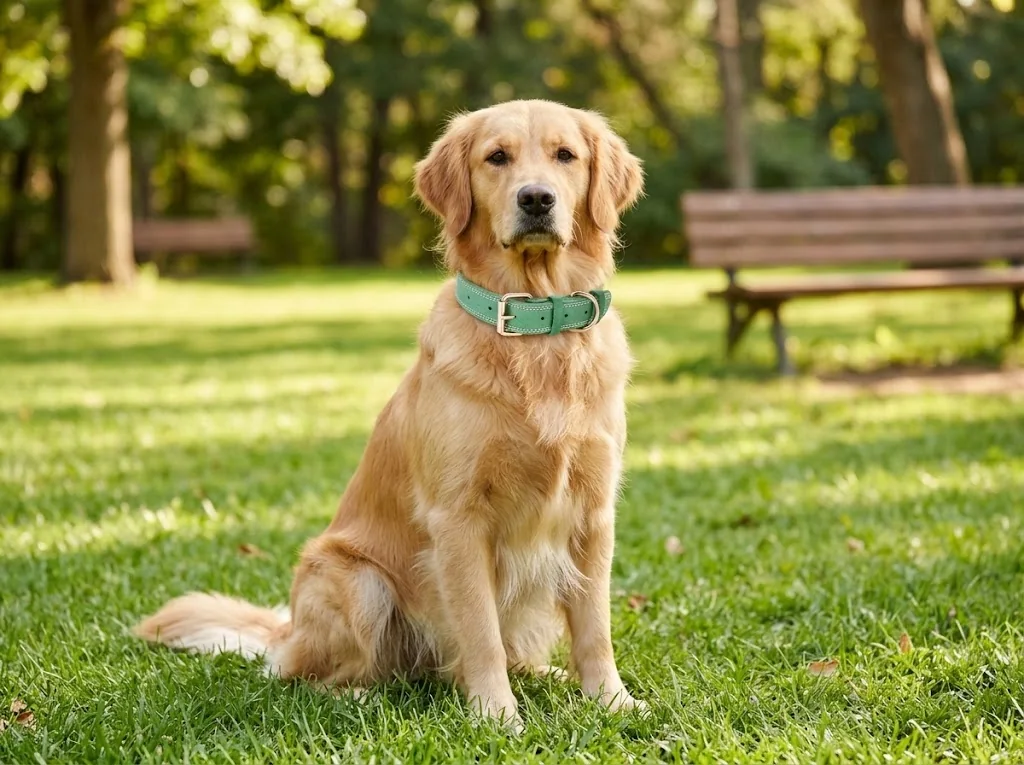
What Counts as a Genuine Leather Dog Collar?
The term sounds precise but is used loosely. In trade usage, “genuine leather” can describe anything made from real animal hide, from top-grain cowhide to lower-grade split leather. Bonded or reconstituted leather made from scraps is a separate and weaker material. Buyers should ask which layer of the hide is used, because that determines strength, surface quality and how the collar ages.
Genuine leather collars generally fall into a few construction types:
Flat collars: a single strip of leather with a buckle, the most common format for everyday wear.
Rolled collars: leather folded or rolled into a rounded profile, often chosen for longer-coated breeds.
Padded or lined collars: leather over a soft backing, aimed at comfort and a more upscale look.
Stitched or layered collars: two layers bonded and sewn, giving more rigidity and a thicker edge.
Beyond the strap itself, the hardware setup defines what the collar is for. A single ring suits basic leash attachment. A second ring lets the owner carry an ID tag separately from the leash clip, so the tag does not bear leash load.
The American Kennel Club lists leather among the durable materials worth considering for adult dog collars, and says the choice should reflect the dog’s size, activity habits and intended use. It also points to the D-ring, the finish of the leather edges, and wearing comfort as details to check, and advises sizing to the dog’s actual neck measurement with suitable space left between collar and neck.
Source: American Kennel Club, Choosing the Right Collar for Your Dog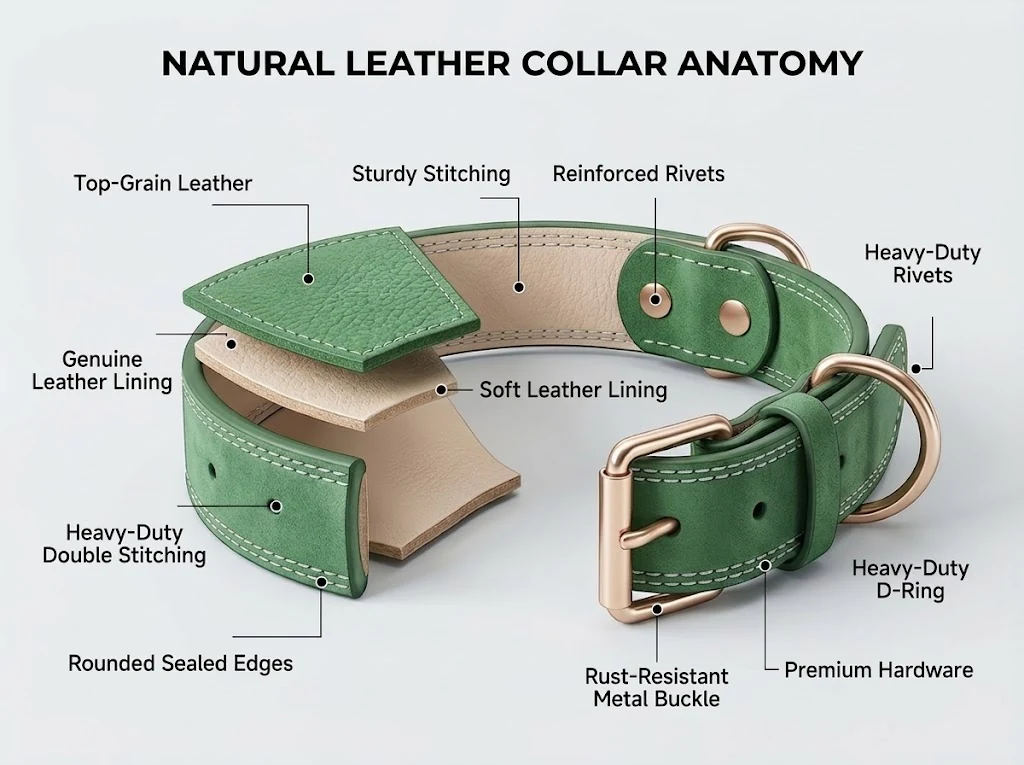
The Dimensions That Decide Quality
Most sourcing problems come from evaluating collars on appearance alone. These are the dimensions that separate a dependable supplier from a risky one.
Leather grade and thickness. Top-grain hide holds its structure and develops a consistent surface. Thickness affects stiffness, weight and how the collar feels at the neck. A thick strap suits a larger frame but can feel heavy on a smaller one, so thickness should be matched to the size range, not set once for the whole line.
Edge finishing. Raw or poorly burnished edges are where wear starts. They can fray, crack or feel rough against skin and coat. AKC’s mention of edge treatment reflects this: it is a functional detail, not decoration.
Stitching. Thread type, stitch density and where the stitching sits relative to load points (around the buckle and rings) determine whether the collar fails at the seam. Stitching can also be a branding element through contrast color.
Hardware. Buckle, rings and any fixings are the most common point of failure. Check the metal type, plating or finish, how the rings are attached, and whether the hardware matches the strap width. A strong strap with weak hardware still fails.
Sizing range and fit logic. A collar range needs sensible overlap between sizes and enough adjustment holes to cover real neck measurements. Poor size spacing leads to fit complaints that have nothing to do with material quality.
Finish and color consistency. Natural hide takes dye unevenly. A good factory manages this within a batch and across repeat orders. Buyers planning reorders should ask how color matching is handled over time.
The usual trade-off is between thickness and comfort, and between visual refinement and cost. Extra layers, hand-finished edges and premium hardware all add durability and perceived value, and all add unit cost. The right balance depends on where the brand sits in its market.
How Leather Compares With Other Collar Materials
Leather is not the right answer for every product line. This comparison shows where it fits.
| Dimension | Genuine leather | Nylon / polyester webbing | Coated synthetic (PU/PVC-type) |
|---|---|---|---|
| Perceived value | High, premium positioning | Entry to mid-range | Mid-range |
| Appearance over time | Develops character with wear | Can fade and fray | Stays uniform, may crack or peel at the surface |
| Water exposure | Needs care; not ideal for constant wet use | Handles water well | Generally water-tolerant |
| Customization depth | Thickness, color, stitching, hardware, embossing | Print, webbing color, woven patterns | Color, shape, some embossing |
| Cost position | Higher per unit | Lower per unit | Moderate |
| Material variability | Natural variation between hides | Highly uniform | Highly uniform |
| Best fit | Premium, lifestyle and fashion-led ranges | Volume and active-use ranges | Waterproof or outdoor-leaning ranges |
The natural variation in leather is both a selling point and a quality-control challenge. Synthetic options win on uniformity and water tolerance. Leather wins on material story and the ability to build a distinctive, brand-led product. Many retailers carry both, positioning leather as the upgrade tier.
Efficiency and Value: What the Unit Price Doesn’t Show
A leather collar costs more per unit than webbing, so the comparison that matters is cost per sale that stays sold. A few factors drive that:
Return and complaint exposure. Hardware failure, seam splitting and rough edges are the typical causes of returns in this category. A lower unit price that brings higher failure rates often costs more once returns, replacements and review damage are counted.
Price positioning. A premium material supports a price tier that webbing cannot reach, so margin per unit can hold up even when cost per unit is higher.
Range efficiency. Four well-spaced sizes in one construction can cover a broad range of dogs without a sprawling SKU list, which keeps inventory simpler.
Reorder consistency. A supplier that can match leather color and finish across production runs protects the brand’s look and avoids mismatched stock on the shelf.
For brands developing their own line, the question is less “what is the cheapest collar” and more “what level of finish can this supplier hold reliably across batches”.
How YuanFei Pet’s Genuine Leather Dog Collar Applies These Dimensions
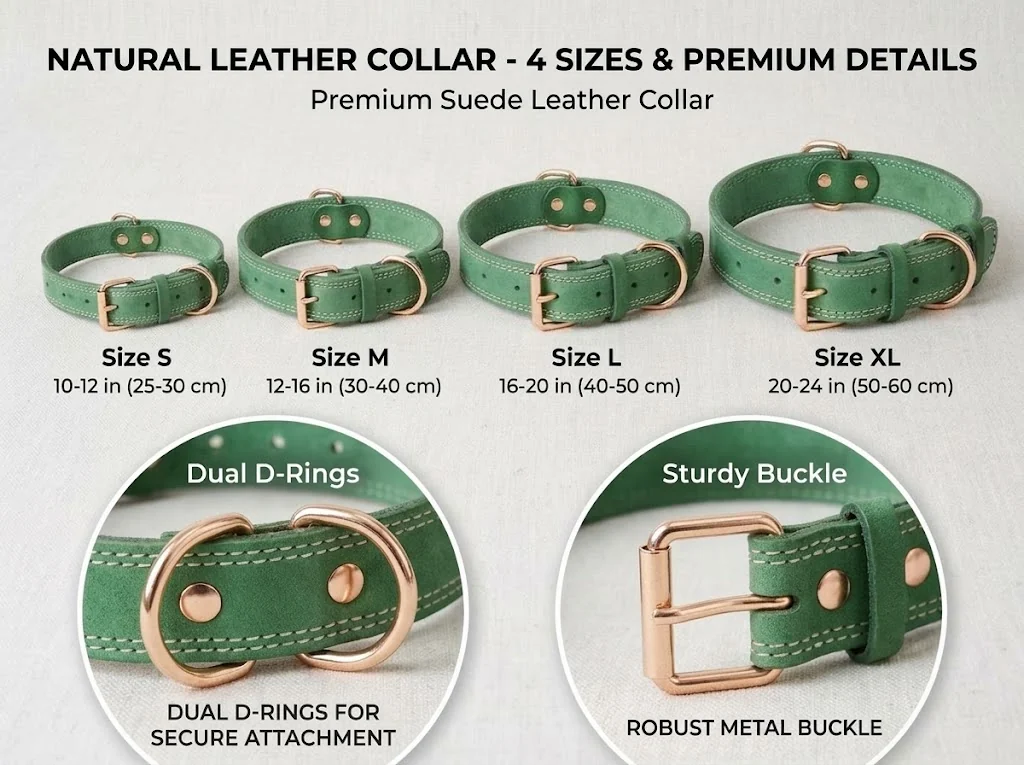
YuanFei Pet’s Genuine Leather Dog Collar is made from top-grain cowhide with a metal buckle and double D-rings. One ring is for leash attachment and one for an ID tag, which addresses the dual-purpose hardware logic described above.
The collar comes in four sizes (S, M, L, XL). Strap width runs from about 2.03 cm to 3.56 cm, and the range fits neck circumferences of roughly 34 cm to 65.5 cm. The width progression across sizes is how the range handles the thickness-versus-comfort trade-off: narrower straps on smaller sizes, wider on larger ones.
For brands that want their own product rather than a catalog item, the customization options cover leather thickness, color, stitching, hardware and logo. Packaging customization and OEM/ODM development are also available, which makes this collar a workable base for brands building a private-label leather line.
Working With a Leather Dog Collar Manufacturer
Choosing a leather dog collar manufacturer comes down to whether the factory can control the variables above and show evidence of doing so. Useful signals include a clear answer on which hide layer is used, sample collars that reflect production quality and not only showroom pieces, and a willingness to discuss how defects are handled.
A premium leather dog collar supplier should also be able to explain what changes when you customize. Switching hardware, thickness or stitching colors affects lead time, tooling and minimums, and a transparent supplier will explain those effects up front instead of after the order is placed.
For a genuine leather dog collar OEM program, the practical test is whether the factory can hold a specification across repeat orders. A single good sample proves little. Consistency across batches is what protects a brand’s reputation.
A genuine leather dog collar is a premium material choice that pays off when grade, finishing and hardware are specified and controlled, and it becomes a source of returns when they are not.
YuanFei Pet: Your Professional Supply Chain Partner for Genuine Leather Dog Collars
As a professional pet product manufacturer and supplier, YuanFei Pet has deep expertise across the Genuine Leather Dog Collar supply chain, with mature production processes and full OEM/ODM capability, supporting brand customers from spec customization and packaging design through to bulk delivery.
Our factory holds ISO 9001 (Quality Management), ISO 14001 (Environmental Management), and ISO 45001 (Occupational Health & Safety) certifications (Certificate No.: 10426Q00119R001 / 10426E00081R001 / 10426S00081R001). Product test reports for EU REACH and other buyer-specific requirements are available on request.
Launch Your Genuine Leather Dog Collar Line
Looking for a reliable supply chain partner, or want to learn more about genuine leather dog collar specifications and customization options?
📧 Email us at [email protected] for product technical data and free test samples
Frequently Asked Questions (Q&A)
Q1: How should I evaluate a leather dog collar manufacturer before placing a first order?
A1: Start with samples taken from production, not only from a showroom. Ask which hide layer is used, how edges are finished, and how stitching and hardware attachment are handled. Request details on how defects are inspected and what happens when a batch does not meet the agreed specification. A factory visit or video audit adds further confidence.
Q2: What quality checks matter most for leather collars?
A2: The most failure-prone points are hardware attachment, seam strength near the buckle and rings, edge finishing, and color consistency within a batch. Ask the supplier how each is inspected during and after production, and agree on acceptance criteria in writing before the order.
Q3: What is the difference between genuine leather, top-grain leather and bonded leather in sourcing terms?
A3: “Genuine leather” is a broad term for real hide and can cover a range of grades. Top-grain refers to the upper, stronger layer of the hide. Bonded leather is made from reconstituted scraps and is a different, generally weaker material. Always ask for the specific grade in writing and confirm how local labeling rules in your target market treat these terms.
Q4: How do customization choices affect a leather dog collar bulk order MOQ?
A4: Minimums generally rise with the depth of customization. Standard catalog items usually carry lower minimums than orders with custom hardware, special dye matching or new tooling. Ask the supplier for a breakdown by customization level, since each element can carry its own requirement.
Q5: What should a custom leather dog collar private label program include?
A5: At minimum: agreed material grade and thickness, color and stitching specifications, hardware choice, logo method and placement, and packaging. A good program also documents an approved reference sample so later reorders can be matched against it.
Q6: How can I reduce return risk when adding leather collars to my range?
A6: Focus on the common failure points: hardware strength, seam placement, edge finish and sizing accuracy. Choose a size range with sensible overlap, and make sure product pages state measurements clearly so fit problems do not turn into returns.
Q7: What customization options does YuanFei Pet offer for its Genuine Leather Dog Collar?
A7: YuanFei Pet supports customization of leather thickness, color, stitching, hardware and logo, and offers OEM/ODM development and packaging customization. The collar is available in S, M, L and XL, with strap widths of about 2.03–3.56 cm and neck circumferences of roughly 34–65.5 cm.
Q8: How do I confirm that reorders will match the first production run?
A8: Keep an approved reference sample and a written specification covering hide grade, thickness, dye color, stitching and hardware. Ask the supplier how they manage color matching across hides and dye lots, and check incoming batches against the reference.