How Durable Chew Dog Toys Help Pet Brands Build a More Competitive Product Line
Introduction: Dog Toy Sourcing Logic Is Shifting from “Cheap and Easy to Sell” to “Durable and Verifiable”
The sourcing criteria for the pet toy category have shifted noticeably in recent years. In the past, competition centered on who was cheapest and who launched new products fastest. Today, brands and buyers care more about whether a toy can withstand a dog’s real bite force, and whether material safety can be backed up with third-party test reports.
This shift is backed by data. According to the Pet Toys Market Report published by Grand View Research, the global pet toy market was valued at roughly USD 10.61 billion in 2025 and is projected to grow to USD 22.42 billion by 2033, at a CAGR of 9.9%. Chew toys accounted for about 25.4% of the pet toy market in 2025, and dog-related products made up more than half of the market (52.1%).(Data sources: Grand View Research – Pet Toys Market Report;)
Another report focused specifically on the “bite-resistant / indestructible” sub-category (Dataintelo, Indestructible Dog Toys Market) offers more granular figures: this sub-segment was valued at about USD 3.8 billion in 2025 and is projected to reach USD 7.1 billion by 2034, at a CAGR of about 7.2%. Chew toys account for 38.4% of that sub-segment, roughly USD 1.46 billion. In other words, “chew durability” is no longer a niche selling point — it is one of the fastest-growing directions in the entire dog toy category.(Data sources: Dataintelo – Indestructible Dog Toys Market Research Report)
This shift is closely tied to the shortcomings of traditional toys. Plush toys are easily torn open, and once the stuffing is exposed there is a risk of ingestion; cheap rubber or plastic toys tend to crack and shed debris under the bite force of medium and large dogs, and the resulting sharp fragments are also a safety hazard. When conducting safety testing, the industry generally emphasizes that a dog’s destructive force far exceeds that of a child, and that testing needs to simulate sustained, real-world chewing rather than just a standard drop test.

What Is a Durable Dog Chew Toy?
A durable dog chew toy is a functional product designed specifically around dogs’ natural chewing behavior. The core consideration is not how good it looks, but material hardness, tear resistance, and how long it holds up in real-world use.
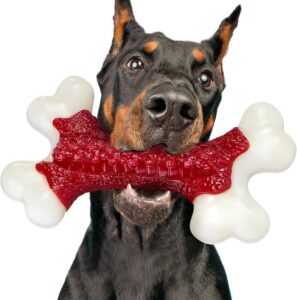
Common materials on the market fall into a few main categories — nylon, TPR, and natural rubber. Among them, nylon has high density and strong abrasion resistance and does not tear apart easily, making it one of the most widely used materials for chew products aimed at medium and large dogs. Lolostar’s Durable Dog Chew Toy line uses nylon as its recommended material, with material, size, color, and pattern all customizable to brand requirements, suitable for the full growth range from puppy to adult dog.
Why Has Chew Durability Become a Core Purchasing Criterion?
1. Dogs' bite force far exceeds expectations — material strength must match dog size
The destructive force a dog toy has to withstand in real use is on a completely different scale from that of a children’s toy — which is why professional pet toy safety testing specifically emphasizes “simulated sustained chewing” and “material stability in a saliva environment,” rather than just standard drop and pull tests. Before selecting a material, brands need to first think clearly about the target dog size: bite force varies greatly between small and large dogs, and if a given toy is used with the wrong size range, it can be chewed apart within a short time — turning it into a safety issue instead.
2. Safety compliance is a de facto threshold for US/EU channels, even without a mandatory regulation
Interestingly, neither the US CPSC nor the EU Toy Safety Directive directly regulates pet toys — from a regulatory standpoint, pet toys are not subject to mandatory safety standards the way children’s toys are. In practice, however, mainstream retail and e-commerce channels such as Amazon, Chewy, and Petco generally require suppliers to provide third-party test reports for ASTM F963 (mechanical and chemical safety) and EN71-3 (heavy metal migration limits), and SVHC screening for substances of very high concern under REACH is also a common entry requirement for EU customers. While these standards are not “legally mandatory,” they have become the industry’s de facto ticket to entry.
3. Dental care and behavior management functions are becoming a new point of differentiation
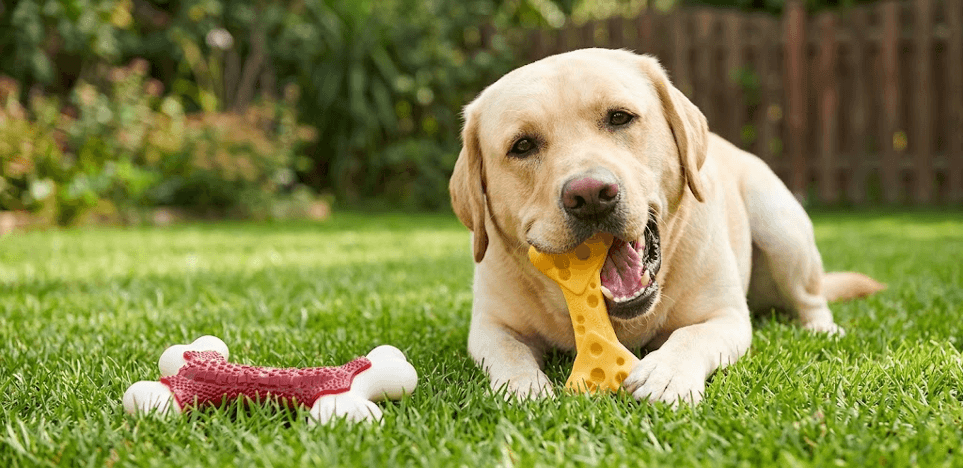
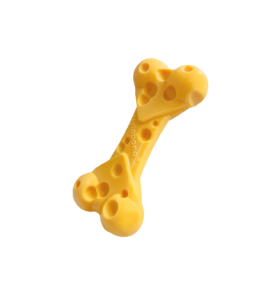
Looking at the category structure of the US dog toy market, training toys accounted for about 47.6% of the market in 2025 and chew toys accounted for 42.9% — the two fastest-growing sub-categories at present. This also explains why compound designs combining “treat-stuffable + dental-cleaning texture + flavoring” are becoming increasingly popular — they upgrade a simple chew toy into a combined “training + oral care” tool, meaningfully extending a dog’s focused play time in a single session. Lolostar’s Cheese Bone Power Chew Toy is a product built around this idea: a 3-in-1 design that can be stuffed with treats, features a dental-cleaning texture on the surface, is flavored throughout (cheese scent), and is available in multiple bone-shaped options.(Data sources: Future Market Insights – United States Dog Toys Market Report; publicly available industry material on pet toy safety testing practices.)
Comparing Common Chew-Resistant Materials
Based on material and construction, durable dog chew toys on the market can generally be grouped into the following categories:
Material | Characteristics | Typical Use |
Nylon | High hardness, strong abrasion resistance, resists tearing — the mainstream choice for chew products aimed at medium and large dogs | Medium/large dogs, heavy chewers |
TPR | Good flexibility, strong rebound, relatively soft bite feel | Small/medium dogs, puppies in the transition stage |
Natural rubber | Moderate elasticity, highly moldable, suited to irregular or hollowed-out structural designs | All dog sizes, interactive treat-stuffing toys |
Standard plastic / plush | Low cost, but weak chew resistance — prone to breaking apart and shedding debris under prolonged chewing | Short-term supervised play, light chewing scenarios |
Different materials each have their own strengths in hardness, cost, and design freedom. Buyers need to select a material mix based on the target market’s dog-size distribution and usage scenario (everyday household use vs. high-frequency use at a boarding facility), rather than comparing on price alone.
Design Logic Behind Two Representative Products
1. Durable Dog Chew Toy — The Basic Line
Material, size, color, and pattern are all fully customizable, with nylon as the recommended material. Suitable for the full growth range, and well suited for brands looking to build out an entry-to-mid-tier price product line.
2. Cheese Bone Power Chew Toy — The Functionally Upgraded Line
Built on a 3-in-1 design: treat-stuffable, dental-cleaning surface texture, and flavored throughout, with multiple shape options available. This kind of compound design — combining function, flavor, and dental care — essentially positions the product within the fast-growing training and oral-care toy segments, and makes it easier to create a differentiated selling point at the retail end rather than competing on price alone.
Key Points to Confirm When Sourcing Durable Dog Chew Toys
● Whether the material hardness matches the target dog size — large dogs bite harder, and an under-spec’d material can be chewed through in a short time;
● Whether the supplier can provide third-party test reports such as ASTM F963 / EN71-3, especially if you plan to enter channels with strict compliance requirements such as Amazon or Petco;
● MOQ and sampling lead time, and whether logo, color, and packaging customization are supported;
● Whether the supplier has genuine export experience to the US/EU market — which mainstream retail or e-commerce clients they have served says more about supply chain maturity than price alone.
What Factors Typically Affect the Purchase Price of Durable Dog Chew Toys?
Pricing for durable dog chew toys is not a fixed number. Material choice, structural complexity, packaging format, and MOQ all directly affect the final cost. Even among products positioned as “durable,” the price gap between an economy tier and a premium tier can be quite significant.
From Raw Material to Finished Product: How Is Production and Quality Control Handled?
Durable dog chew toys go through multiple production stages from raw material to finished product, and every step affects the final product’s chew durability and safety. Beyond the third-party testing mentioned earlier, reliable factories typically also set up quality checkpoints at incoming materials, in-process production, and finished-goods stages to ensure consistency across every batch.
Lolostar's Durable Dog Chew Toy Manufacturing Capability
Lolostar’s durable dog chew toy production line comes from the group’s pet toy factory in Wenzhou — established in 1998, with over 650 employees and a 53,200 sqm production facility. It serves as the core production base within Lolostar’s supply chain focused on pet toys and accessories, and has long supplied mainstream US/EU retail and e-commerce channels including PetSmart, Amazon, Chewy, Walmart, Petco, and zooplus.
Backed by this manufacturing base, Lolostar can provide brand customers with end-to-end support — from material selection and structural design through mass production and packaging customization — and can also help arrange third-party testing such as ASTM F963, EN71-3, and REACH based on the target market’s compliance requirements. Whether you’re looking for a cost-effective basic volume product or want to move into the training / dental-care functional upgrade direction, further development can be done on top of existing product lines.
Want to Learn More?
If you are evaluating supply chain partners for durable dog chew toys, or would like detailed specifications and sample pricing for the Durable Dog Chew Toy / Cheese Bone Power Chew Toy:
📧 Email: [email protected] to get product information and sample pricing
FAQ: Common Questions About Sourcing Durable Dog Chew Toys
Q1: Who is a durable dog chew toy best suited for?
It’s well suited for pet brands, importers, and wholesalers looking to expand their dog toy product line — especially those planning to enter channels with stricter compliance requirements, such as Amazon, Chewy, or Petco.
Q2: Can durable dog chew toys be OEM customized?
Yes. Material, size, color, pattern, and packaging can all be customized to brand requirements, and functional extensions based on existing products (such as the Cheese Bone Power Chew Toy) are also supported — for example, changing the flavor or adjusting shape proportions.
Q3: How should I choose among common chew toy materials?
For medium/large dogs or heavy chewers, nylon is generally the preferred material; for small/medium dogs or puppies in the transition stage, TPR or natural rubber offer a softer feel. The final choice should also account for the dominant dog-size distribution in your target market.
Q4: Are ASTM F963 or EN71-3 test reports always required for sourcing?
From a regulatory standpoint, neither standard is mandatory for pet toys, but mainstream channels such as Amazon and Petco generally require suppliers to provide the relevant test reports. It’s best to confirm testing arrangements with your supplier at the sampling stage, to avoid getting stuck on compliance later when listing the product.
Q5: How can I tell whether a durable dog chew toy supplier is reliable?
A few things to look at: a genuine track record serving mainstream US/EU retail or e-commerce clients, the ability to provide third-party test reports, flexibility on sampling and MOQ, and the factory’s actual production capacity and years in operation — these say more about supply chain stability than price alone.
Dog Chew Toys Series Navigation
1. Why Are Durable Dog Chew Toys Becoming an Important Product in the Pet Supplies Market? (Current Article)
2. What Are the Differences Between Dog Chew Toys of Different Materials? How to Choose the Right Product for Your Target Market?
3. What Is the Demand and Development Trend for Durable Dog Chew Toys in the US/EU Market?
4. What Is the Cost Structure of Durable Dog Chew Toys? How to Evaluate Value for Money When Sourcing?
5. How to Assess a Durable Dog Chew Toy Supplier’s Qualifications and Quality Control Capability? A Sourcing Guide
6. What Does the Production Process for Durable Dog Chew Toys Look Like?
7. OEM and Private-Label Customization Solutions for Durable Dog Chew Toys
8. How Is Quality Control and Testing Done for Durable Dog Chew Toys?